



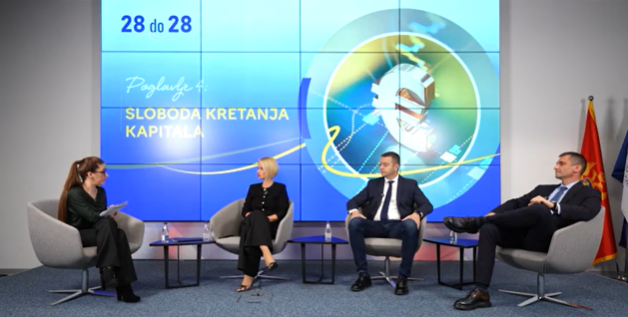

Chapter 4 in Montenegro’s negotiations with the European Union (EU), which aims to enable free, simple, and secure movement of capital without administrative barriers, should be closed by mid-December, said the head of the negotiating working group Bojana Bošković.
She explained that Chapter 4 – Free Movement of Capital refers to transactions related to money and financial instruments between countries, and these transactions are related to investments and trade.
“In this context, types of capital movement can be direct investments. These are investments in enterprises, companies, real estate in other countries. They can be portfolio investments. These are investments in securities, that is, shares or bonds. And they can be credit operations and loans, that is, loans granted by banks and international financial institutions,” said Bošković.
Asked what were the key challenges during the negotiation process, Bošković explained that Chapter 4 is one of the few where there were no special systemic challenges.
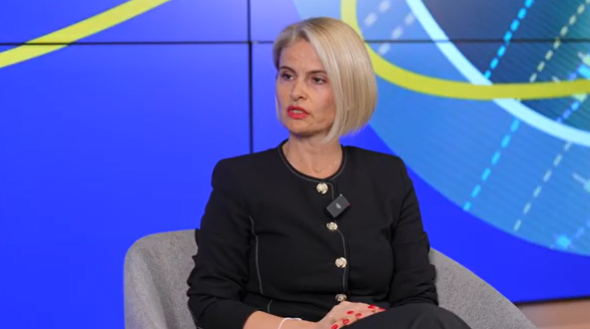
She reminded that Montenegro adopted the Law on Current and Capital Transactions with Abroad back in 2005, which fully liberalized all current and capital movements.
“The very fact that we did not have to change that law to close this chapter shows that we really established that regime starting from 2005. So everything that happened afterwards was just fine-tuning and perhaps minor amendments of certain laws that constituted the framework for the free movement of capital in Montenegro, and of course what involves the area of payment transactions and anti-money laundering, which had to be harmonized because in the meantime new regulations were adopted at the EU level,” said Bošković.
A representative of the Central Bank (CBCG) and member of the negotiating working group, Andrija Jovović, commented on the fulfillment of obligations within Chapter 4 in the area of payment transactions, emphasizing that this area had a key role because the quality, stability, and compliance of the payment infrastructure ensures that capital flows smoothly, efficiently, and through secure channels.
According to him, the previous period saw a very intensive period of harmonization, that is, modernization of the payment system, which, in addition to the technical aspect, also involved the need for regulatory alignment.
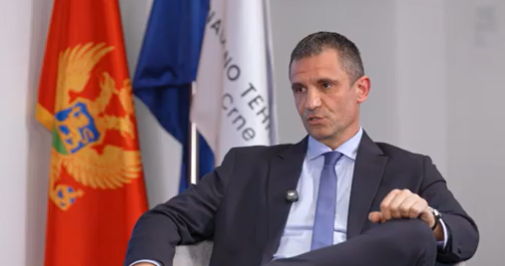
“All these activities we have carried out are strategic and they show Montenegro’s commitment to ensuring efficient movement of capital, which is the very essence of this chapter. And this is proof that Montenegro is entering the final phase of negotiations with functional, efficient, and EU-harmonized payment systems,” said Jovović.
At the beginning of October, Montenegro became a member of the SEPA system – the single euro payments area, which is an EU initiative to simplify and standardize payment transactions, enabling faster, cheaper, and safer payments and transfers in euros between member countries. Jovović emphasized that Montenegro’s accession to the SEPA zone is one of the most visible and concrete reform processes within Chapter 4.
“This is one of the segments that most directly affects the everyday life of our citizens and the functioning of the economy. SEPA has made euro payments performed exactly the same, regardless of whether transactions are made to any EU member state or within the SEPA area,” added Jovović.
According to him, SEPA has brought concrete benefits for citizens and the economy in terms of faster, simpler, and significantly cheaper fees than before, because SEPA introduced standardization that shortens execution time and eliminates all additional costs that previously occurred through intermediary banking.
“The very feeling that the physical border in money transfer practically no longer exists represents the essence of European freedom of capital movement,” said Jovović.
He added that for the economy, this is an even more important step, because Montenegrin companies now operate under the same rules as competing companies in the EU.
Jovović emphasized that SEPA was not just technical harmonization but an integration process and entry into the European financial market.
“On October 7, when the first SEPA payment transactions began, we became part of the EU long before full membership planned for 2028. And SEPA is precisely the best practical example of the benefits that full membership brings – free, simple, and secure movement of capital without administrative barriers. What we have been repeating lately is that SEPA in the European integration process represents that silent revolution, because it brings concrete benefits without much noise and changes the way payments work,” said Jovović.
Commenting on the next steps in the area of payment transactions and the new services and infrastructure planned, Jovović announced that we are entering a phase in which Montenegro introduces solutions representing the modern European top.
“It is about introducing an instant payment system which we are implementing through the TIPS Clone project in cooperation with the Bank of Italy, the European Central Bank (ECB), and the World Bank (WB). In the first phase, we will introduce instant payments for national payment transactions. That means no more waiting until tomorrow. Transactions are executed immediately and funds are available to clients in accounts within a few seconds,” said Jovović.
The second phase of this project involves regional linking between the countries participating in this project, and the third phase involves connection to the real Target Instant Payment system used by EU member states.
“Then you will be able to receive and send money to and from any EU country in just a few seconds,” said Jovović.
According to him, estimates are that annual savings from the introduction of the instant payment system, in combination with the SEPA project, will reach 160 million EUR, which is significant savings at the economic level.
The Director of the Financial-Information Unit (FOJ) and member of the negotiating working group, Aleksandar Radović, speaking about their role in the work of the working group, said that this unit monitors the institutional framework regarding the anti-money laundering and counter-terrorism financing system, cooperation between competent supervisory and investigative bodies, as well as international cooperation.
He explained that AML rules, which involve anti-money laundering regulations, are actually a mechanism that will ensure that the freedom of capital movement is not complete freedom, i.e., that so-called “dirty capital” does not pass through this capital.
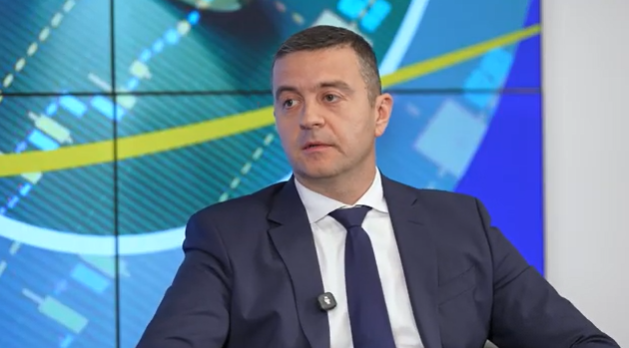
Speaking about the challenges in this chapter, Radović said that the deadline for applying EU rules, directives, and regulations is very short.
“We no longer have the luxury to slowly implement the rules. We decided to adopt the rules of the European family because we are knocking on the EU door. However, sometimes those rules are not entirely in line with our heritage and the situation in the country and socio-political circumstances,” said Radović.
FOJ, he said, had concrete benefits through the negotiation process, as it improved cooperation with supervisory authorities.
Asked whether Montenegro has enough human capacities to fully enter the fight against money laundering, Radović replied that money laundering is a very widespread phenomenon in the world and especially in our country.
“So, I do not know how many human capacities you can determine, they will always have work. Two and a half years ago we had 27 employees. Later we increased the number of jobs twice through systematization, so now it looks like 45 employees, of which 35 work actively. That means we have ten vacant positions,” said Radović.
According to him, the challenge is to find people who can do this work.
“We are slowly raising those capacities. At the level of the Ministry of Interior, regarding capacity, we are at an advanced level. It can always be better, but given all the circumstances and what we have, we can say we are satisfied. However, so much still lies ahead,” said Radović.
Money laundering in recent years, both in the world and in Montenegro, is taking on a different dimension and rules must be written quickly and efficiently and applied.
“This is a huge and specific job, and I think you will not find any country in the world that will say it has 100 percent established the prevention system and investigates 100 percent of money laundering. Three to five percent of global gross domestic product relates to dirty money, and that fact shows how widespread this phenomenon is and how difficult and possible the fight actually is,” warned Radović.
Summarizing the work of the entire working group, Bošković emphasized that the EU accession process implies that institutions must be reformed and made efficient.
“To have efficient institutions, we must also have efficient civil servants, because institutions are made up of people. To be able to boast today what we have done in Chapter 4 and other chapters, it means that some civil servants worked very diligently. Colleagues talked about the fact that we lack capacity and that we must build those capacities. The fact that we achieved all these reforms with so few people means that the success of those colleagues who worked twice as hard is even greater, because we did it in limited capacity conditions,” said Bošković.
Source: mina.news