



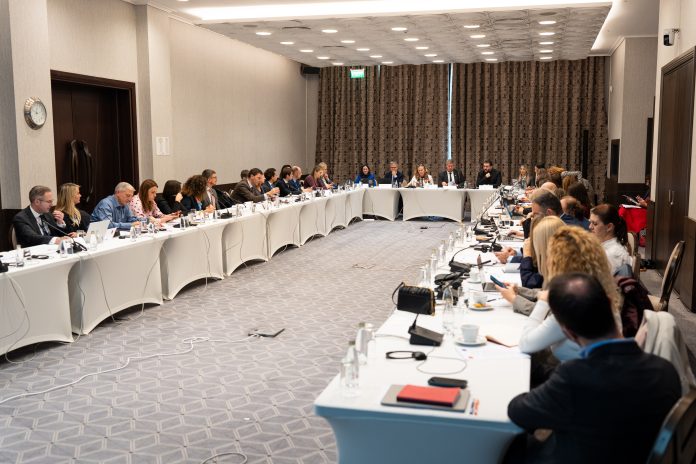

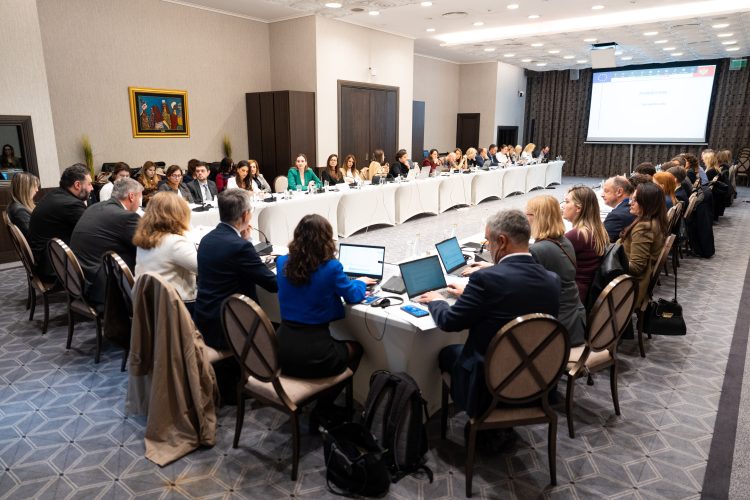
The regular annual meeting of the IPA Supervisory Committee was held in Podgorica, bringing together representatives of Montenegrin institutions, IPA fund beneficiaries, and partners from the European Commission, to review the results of the implementation of EU support programs from which Montenegro has benefited during the pre-accession period, as well as to define priorities for the upcoming period.
The meeting was co-chaired by representatives of Montenegrin institutions and the European Commission. The meeting was opened by Bojan Vujović, Director General for Coordination of EU Financial Assistance and Deputy National IPA Coordinator, after which Barbara Hesus-Himeno, Head of Unit B4 in the Directorate-General for Enlargement and Neighborhood Policy, and Velibor Damjanović, Director General for Management of EU Pre-Accession Fund Structures at the Ministry of Finance, addressed the attendees.

Participants highlighted the strong engagement of national institutions in the EU accession process. Montenegrin institutions have gained significant experience in managing EU funds over several IPA cycles, while national systems have been further strengthened to ensure that future, larger volumes of funds are used effectively and for the benefit of citizens. In the context of strengthening human resources, it was highlighted that the Government adopted an employment plan foreseeing 100 new positions in the fund management system, with implementation planned for 2026.
Since the beginning of the IPA III programming cycle, Montenegro has been allocated over €390 million in EU support in key reform sectors, including transport, environment, energy, agriculture, public administration reform, rule of law, and employment, explained Bojan Vujović. On this occasion, he pointed out support of €150 million in EU funding for the Mateševo–Andrijevica section—a capital project that will modernize Montenegro’s transport network and significantly improve regional connectivity.

He emphasized that Montenegro has also made significant progress in negotiating Chapter 22 – Regional Policy and Coordination of Structural Instruments, thanks to the adoption of a new Action Plan and accompanying documents, which will help the country prepare for the use of future EU cohesion funds. He explained that these documents were developed through an inclusive process, including public consultations held in October 2025.
European Commission representative Barbara Hesus-Himeno emphasized that Montenegro, as a frontrunner in the EU accession process, should make the best possible use of available IPA funds to meet the final benchmarks in negotiations and prepare for EU membership, in line with Montenegro’s goal of joining the European Union in 2028.

In the final part of the meeting, Velibor Damjanović reported that, thanks to the strong commitment of institutions, almost all IPA III programs are either accredited or in the final stage of accreditation, while European Commission reports confirm that the national system is stable, functional, and ready to manage a larger volume of EU funds. He also pointed out a new program under the Growth Plan, worth €383 million, which further strengthens reform processes and directly supports public finances and citizens.

Participants welcomed the stable and significant progress in the use of IPA funds in Montenegro and once again confirmed their joint commitment to accelerating reforms and ensuring that EU support delivers tangible results for citizens on Montenegro’s path to European Union membership.
MINISTRY OF EUROPEAN AFFAIRS
MINISTRY OF FINANCE