



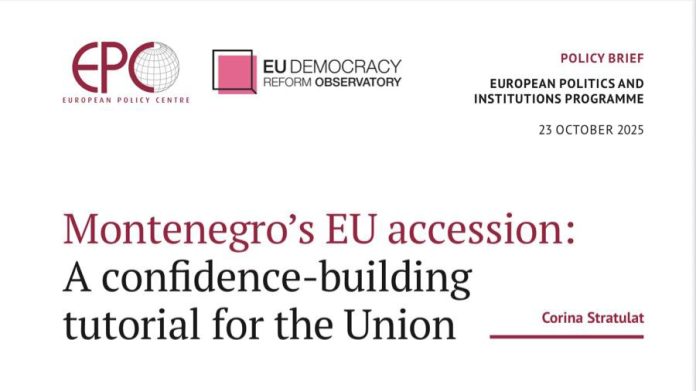

Montenegro’s accession to the European Union would be a low-risk, high-impact way for the EU to demonstrate its credibility and ability to implement the enlargement process, according to an assessment from a summary published by the European Policy Centre, one of the most influential think tanks in Brussels dealing with the analysis and advancement of European policies.
The document states that, by investing the necessary political and technical capital to enable the country’s accession to the Union by 2029, the EU would show that it is ready to step out of its comfort zone, honor its promises, and act decisively.
It is noted that the enlargement process has stagnated over two decades, and that among the current candidates, Montenegro offers the clearest opportunity to translate rhetoric into tangible progress.
“How the EU responds will shape not only Montenegro’s future, but also the future of the wider Western Balkans, the credibility of enlargement policy, and the Union’s ability to demonstrate leadership in line with its global responsibilities,” the summary states.
The document further notes that Montenegro remains the most advanced candidate for membership in the European Union, with all 33 negotiating chapters opened and seven provisionally closed, as well as a reminder that the Government has adopted comprehensive reforms in the areas of the judiciary and the fight against corruption, including amendments to laws on the judiciary, elections, and media freedom.
It is emphasized that, based on this progress, Montenegro aims to close an additional five chapters by the end of 2025, bringing their total to 12—which, in their view, is sufficient for the Council of the European Union to establish a working group for Montenegro’s Accession Treaty.
As an advantage of Montenegro, the document states that GDP growth remains above the Western Balkans average, inflation has declined after pandemic-related spikes, and public debt is decreasing. Compared to its neighbors, Montenegro has a higher level of trade and financial integration with the European Union. The use of the euro as legal tender supports monetary stability and facilitates access to EU markets.
In addition to advantages, the document also points to the need for Montenegro to continue reforms and deliver results in the areas of the judiciary, the fight against high-level corruption, and media freedom, as well as public administration reform.