



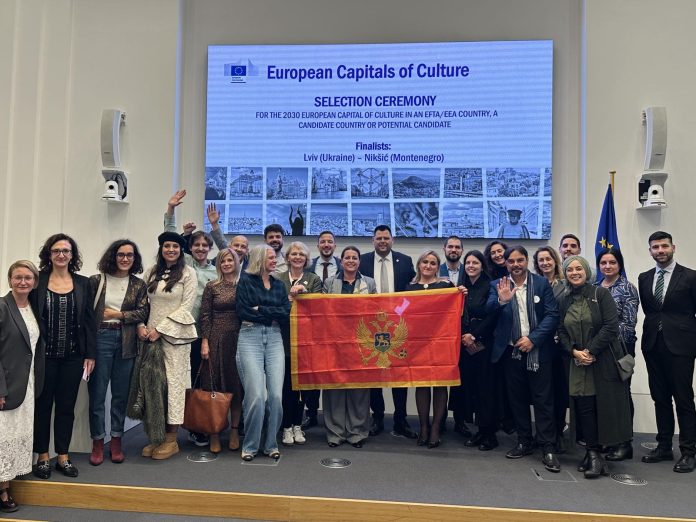

After a two-year long process of preparing the application, in October this year, the Municipality of Nikšić won the title of European Capital of Culture for 2030 – the most important European title in the field of culture that the European Commission has been awarding for 40 years.
Providing statement of reasons for their decision, in the European House, the jury underlined that it was one of the most difficult decisions ever. It is understandable, since the counter-candidate was the Ukrainian city of Lviv. With the population above 750.000 people, Lviv is considered a cultural capital of Ukraine, and it has been in the focus particularly in the last couple of years. Thus, in 2025 it had the title of the European Capital of Youth – a significantly smaller project, but the one that is often considered a preparation for the title of European Capital of Culture.
As a team, regardless of the strong competition, we were determined to do our best. We put efforts into ensuring that, regardless of the final result, our work contributed to the long-term development of the culture in Nikšić and to positioning of Nikšić in the European cultural map. I think that this attitude was decisive for our victory, because it pushed us to think about every detail and not to let anything to chance. It was not only the attitude of the team that prepared the application, but of the entire Municipality of Nikšić that mobilized all its resources and capacities to work on this application in the best possible way. This was reflected in the continuous support and direct involvement of the President of the Municipality Marko Kovačević, but also in the support of all the councillors of the Municipal Assembly of Nikšić who in September jointly supported this idea and adopted a unanimous decision in the Assembly supporting the project in the final stage of application.
The Minister of Culture and the Media, Tamara Vujović, has been strongly supporting the initiative since the beginning. Together with us, she participated in the presentation and defence of the application in Brussels, additionally confirming the willingness of the Government to support the project. Just before the formal submission of the application, the Government voted for a formal information about the support and financing of the project of the European Capital of Culture (ECoC).
Thanks to the decisions of the Government of Montenegro and the Municipal Assembly of Nikšić, the organization implementing the ECoC project can start working already in early 2026. Our plan is not to waste any of the precious time waiting for 2030, and already now, through a number of smaller programmes and activities, to start working on developing the audience, positioning Nikšić as a cultural centre and enhancing the capacities of the sector of culture in general – from institutions and NGO sector to individuals who work or want to work as professionals in culture – as managers, producers, event organizers, international promoters, etc.
The idea is to extend the team for implementation of the project, in the years to come; to include young and enthusiastic people, but also to develop human resources in partner organizations that will be in charge of implementation of concrete projects in 2030. One of the key segments of inclusion of citizens will be a platform for volunteers that will be open for people of different age, skills and motivations – those who can help in technical implementation, correspondents, influencers in social networks or informal promoters of the project in every-day life.
ECoC project has the power to transform the city and help it find a new identity. This is an opportunity to transform Nikšić from a heavy industry centre into a centre of creative industries based on the principles of innovation, digitalization and sustainability. The city will get a new face in terms of cultural infrastructure. The areas that have constituted symbols of stagnation of Nikšić for a long time will be transformed into modern cultural spaces. The best example is the House of Revolution (Dom revolucije), a brutalist building, whose construction started in 1978 based on the design of the architect Marko Mušić. The construction stopped after a decade, leaving an unfinished building in the centre of the city to the mercy of time for more than 40 years.
Already in the candidacy stage, Nikšić showed that it was serious in the intention to finally revitalize this space. Thus, two big projects have already been completed within this complex – new building of the Radio and Television Nikšić, and the House of Digital Revolution that serves as an additional space for the work of IPC Tehnopolis.
The works of the construction of the key space for implementation of cultural events in 2030 – Multifunctional Hall – are currently in progress. It will have the capacity to host a significant number of people for various types of events – concerts, performances, workshops, etc. The crown of the work on revitalization of the House of Revolution will be the construction of the Centre of Digital Culture and Gallery of Modern Art in the dome of the building. In addition to this, the key areas in the city will be revitalized too, like the citadel Bedem, cultural-historical areas around the Castle of the King Nikola and cultural infrastructure in rural and industrial areas intended for decentralization of cultural contents, while Radio and Television Nikšić plans to build a state-of-art film studio.
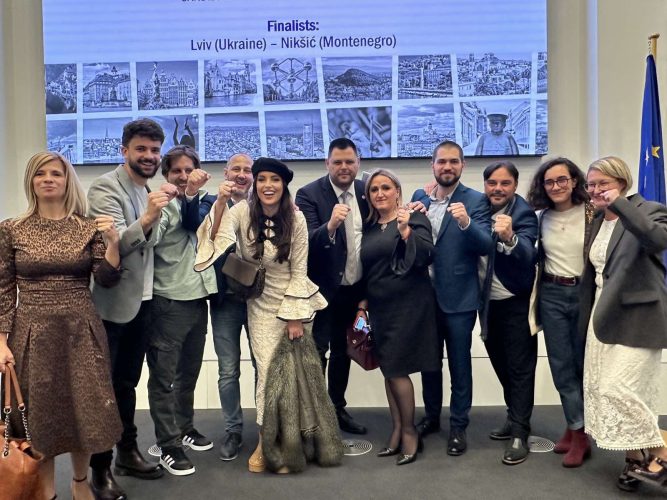
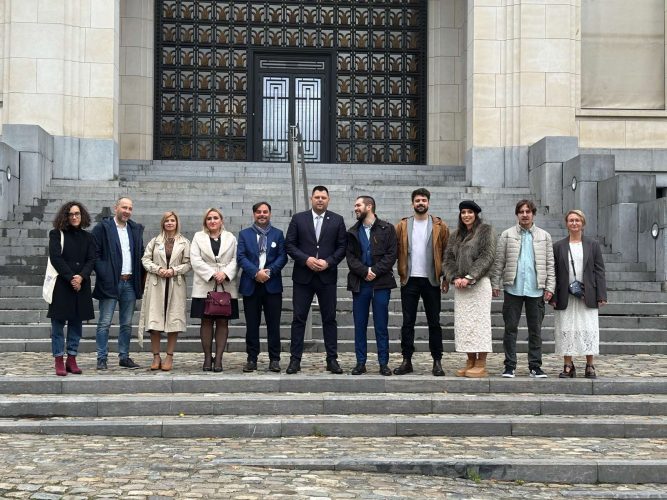
The team that worked on developing the application includes Nemanja Popović, Lucija Strunjaš, Aljoša Matović, Darko Aleksić and me, and the continuous expert support of Vuk Radulović and Sara Vuletić who transfered the experience of Novi Sad. In addition to this, we have cooperated with the key international experts for ECoC projects like Beatriz Garcia and Chris Baldwin and the networks of friends and colleagues from other European Capitals of Culture and creative cities that are members of the Culture Next network together with us. In the presentation of the application in Brussels, in addition to the support of the Minister Tamara Vujović and the mayor Marko Kovačević, we had a huge support of the people who cooperated with the team from the very beginning and gave a significant contribution in preparing the application – adviser for culture, tourism and religious issue, Miljan Mijušković, Nataša Krivokapić (University of Montenegro), Anđela Nikčević (IPC Tehnopolis) and artist Nina Rakojević.
Getting the ECoC title provoked a genuine euphoria in the city and great media visibility on the national level. Therefore, another indeed important title remained in the shadow – the Title of the UNESCO City of Music that Nikšić got only a couple of days later, becoming thus a part of the network of 408 creative UNESCO cities worldwide. The application for the UNESCO City of Music was also implemented by the Office Nikšić 2030, and these two titles will be complementary, positioning Nikšić in the years to come strongly on the cultural map of Europe, and the entire world.
By: Mato Uljarević
This text was published in the 17th issue of Eurokaz magazine.