



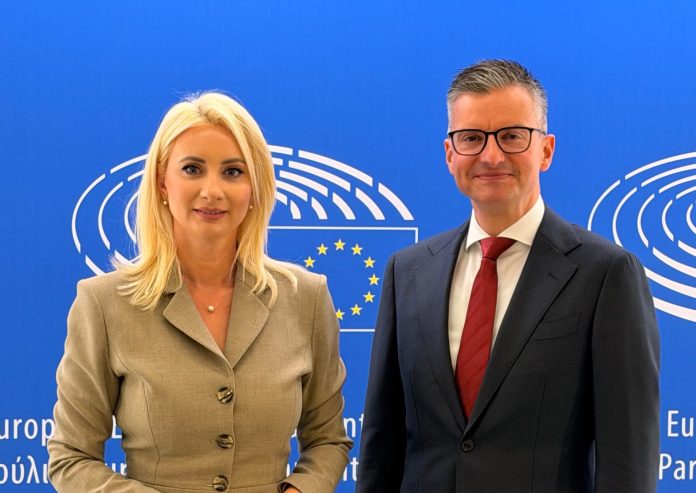

Minister of European Affairs Maida Gorčević participated today, at the invitation of the European Parliament’s Rapporteur for Montenegro, Marjan Šarec, in a roundtable at the European Parliament in Brussels dedicated to the final stage of the accession process, the roadmap and Montenegro’s next steps towards full membership in the European Union.
The roundtable was also attended by Valentina Superti, Director for the Western Balkans at the European Commission’s Directorate-General for Neighbourhood and Enlargement Negotiations (DG NEAR), and Alva Finn, Executive Director of the European Liberal Forum, as well as Clive Rumbold, Senior Expert for the Western Balkans at the European External Action Service, providing an opportunity to exchange views on the political and reform completion of Montenegro’s European path.
“Our goal is clear: to close all remaining negotiating chapters by the end of this year and become the 28th EU Member State by 2028. This ambition is based on measurable results, a concrete timeframe and the continuous work of all our institutions. I believe that together we can make Montenegro’s accession not only a national, but also a European success, as well as a strong confirmation that enlargement can make our Union stronger,” Gorčević said.
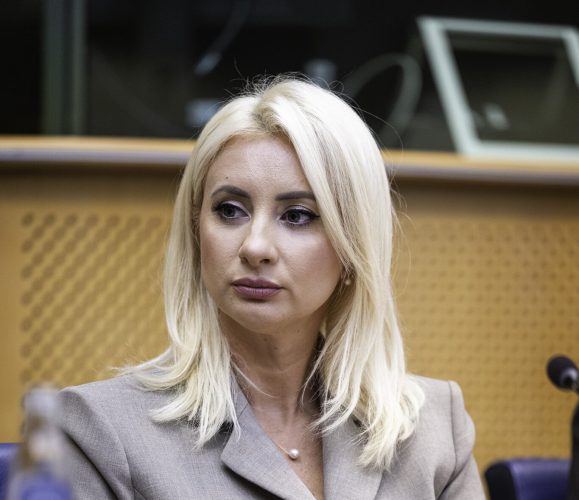
Gorčević stressed that Montenegro’s successful accession would send a much broader message: that reforms deliver results, that the merit-based approach works, and that enlargement remains one of the Union’s most credible and transformative policies. She noted that work on Montenegro’s EU Accession Treaty represents more than a technical step: it is a tangible signal that, following the longest pause in the history of EU enlargement, membership is finally moving from the realm of political ambition into institutional reality.
Rapporteur for Montenegro Marjan Šarec stressed that enlargement is a key activity of the European Union and that, if the EU is not present in the region, someone else will be – or already is.
“Montenegro is a small country and does not pose a threat to the European Union. The real question is whether we are politically ready. This is a geopolitically important region exposed to various foreign influences, which is why the EU must be ready to act and to welcome Montenegro into the Union.”
Šarec also recalled that the European Union is, first and foremost, a peace project. “We must show that we remain fully committed to this peace project.”
He underlined that it is equally important to show the people of the Western Balkans that being part of Europe brings tangible benefits, and that both the enlargement process and the European Union must preserve their credibility. “We should not disappoint citizens. Enlargement is, of course, also a matter of geostrategy, politics and the budget, but above all, it is about people. Fourteen years is a long time to wait, and the European Union needs to meet expectations now.”
In his view, Montenegro can serve as a role model for other candidate countries. “Montenegro’s accession to the European Union would send a clear message that hard work, reforms and commitment pay off.”
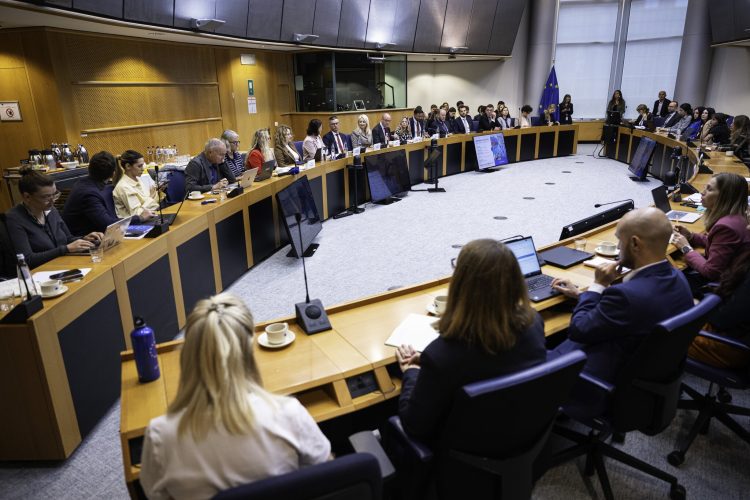
Valentina Superti said that since 2024, Montenegro has made significant progress on its path towards EU membership, following years of relatively limited progress. She noted that the renewed momentum reflects both the changed geopolitical context and Montenegro’s strong political commitment, which is increasingly enjoying the support of broad cross-party consensus. Superti stressed that the European Commission considers Montenegro’s goal of concluding accession negotiations by the end of 2026 ambitious, but achievable. She said that key priorities in the final stage include further reforms in the area of the rule of law, constitutional amendments, good-neighbourly relations and continued consensus among EU Member States.
Clive Rumbold said that Montenegro’s full alignment with the EU’s Common Foreign and Security Policy, its contribution to missions under the Common Security and Defence Policy and its support for Ukraine demonstrate its clear strategic commitment to the European path.
Alva Finn welcomed Montenegro’s progress towards EU membership and called for the acceleration of the enlargement process more broadly. She stressed that the Union must reform the way it makes decisions in order to function better and more efficiently and to become a stronger and more capable Union.
Minister Gorčević and European Parliament Member Šarec also took part in a working breakfast with journalists from more than 20 media outlets from Brussels and EU Member States, where they answered questions about Montenegro’s accession to the European Union.
MINISTRY OF EUROPEAN AFFAIRS