



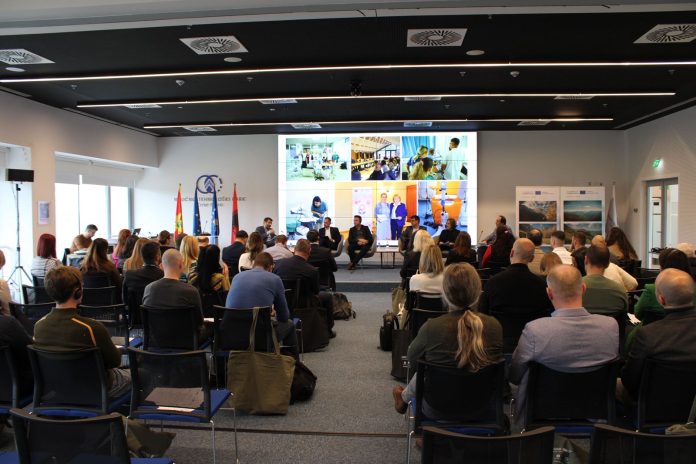

The Ministry of European Affairs of Montenegro organized a Capitalization Event within the Cross-Border Cooperation Programs Montenegro–Kosovo and Montenegro–Albania, bringing together representatives from institutions, local governments, civil society organizations, and project partners from Montenegro, Albania, and Kosovo, with the aim of exchanging experiences, presenting achievements, and identifying new opportunities for cross-border cooperation.
Opening the event, Miloš Marković, General Director of the Directorate for European Territorial Cooperation in the Ministry of European Affairs of Montenegro, stated that cross-border cooperation lays the foundations for the long-term development of the region.
“Good neighborly relations and regional cooperation are the foundation of progress toward the European Union. Through eighty-three implemented projects worth over €25 million, we brought together public institutions, local governments, educational institutions, the civil sector, and numerous partners, who contributed to tangible results through their work. Together, we have advanced employment, especially for vulnerable groups, worked on environmental protection and sustainable resource management, developed tourism through the promotion of cultural and natural heritage, and strengthened the capacities of local communities and institutions,” Marković said.

Rando Kote, Head of the Directorate for European Territorial Cooperation at the State Agency for Strategic Programming and Aid Coordination of the Republic of Albania, emphasized the importance of capitalization and the role of EU values in regional cooperation.
“Capitalization allows us to turn experience into knowledge, knowledge into policies, and policies into lasting impact, ensuring that the results of our projects continue to serve communities and future generations,” Kote said.
Jeton Çelja, State Secretary in the Ministry of Local Governance of Kosovo, highlighted the contribution of local communities and institutions through project implementation.
“The projects and best practices we present today show that when local government is supported and empowered, it becomes a driver of economic, cultural, and social development,” Çelja said.
Sanja Bečanović, Acting General Director of the Directorate for Financing, Contracting, and Implementation of EU Funds in the Ministry of Finance of Montenegro, recalled the concrete benefits of cross-border projects for citizens and local economies.
“Projects implemented under these programs clearly show how cross-border cooperation can bring tangible benefits to citizens – through employment, strengthening local economies, and preserving cultural and natural heritage,” Bečanović said.
Melanie Bride, representative of the European Union Delegation in Montenegro, highlighted the European values and contribution of cross-border cooperation.

“Cross-border cooperation promotes unity, supports development efforts, and helps reduce territorial inequalities, all grounded in shared European values – trust, cooperation, and mutual respect,” Bride said.
Panelists in the session on employment and opportunities emphasized that EU-funded cross-border projects in Montenegro, Albania, and Kosovo deliver concrete results by empowering youth, women, persons with disabilities, and other vulnerable groups through practical skills, mentoring, and support for entrepreneurship. It was stressed that strong involvement of employers, cross-border cooperation, and institutional partnerships are key to sustainable employment and self-employment.

In the panel on tourism and cultural heritage, participants emphasized that successful cross-border tourism relies on authentic local values, strong partnerships, and active involvement of local communities, while carefully balancing development and the protection of natural and cultural heritage. Education, digital tools, ecological standards, and branding of local gastronomy and rural experiences were noted as significant factors in enhancing the quality and competitiveness of destinations. It was concluded that future development should focus on sustainable investments, green transition, and strengthening cross-border networks to ensure long-term impact and resilience of the tourism sector in the region.
The session on Environmental Protection demonstrated that concrete ecological activities and cross-border cooperation have produced visible results in environmental protection and improving the quality of life of local communities. Participants agreed that a joint approach, strong community involvement, and knowledge exchange remain key for successfully addressing shared environmental challenges.
Nada Pejović, Head of the Directorate for Bilateral Cross-Border Programs in the Ministry of European Affairs of Montenegro, presented both programs, with a special focus on opportunities provided under the IPA III financial framework. She highlighted the importance of cross-border cooperation and the potential benefits these programs bring to institutions and local communities.
The event served as a platform for exchanging experiences, inspiring new projects and partnerships, and further strengthening regional cooperation and European integration of Montenegro, Albania, and Kosovo.
MINISTRY OF EUROPEAN AFFAIRS