




“Today, as Montenegro looks toward a certain European future, we all strongly support Nikšić’s efforts to immortalize its cultural heritage and contemporary artistic trends with recognition at the European level. This city has the potential to become a hub for promoting European values and the benefits of EU membership, not only in Montenegro but across the region,” said Minister of European Affairs Maida Gorčević.
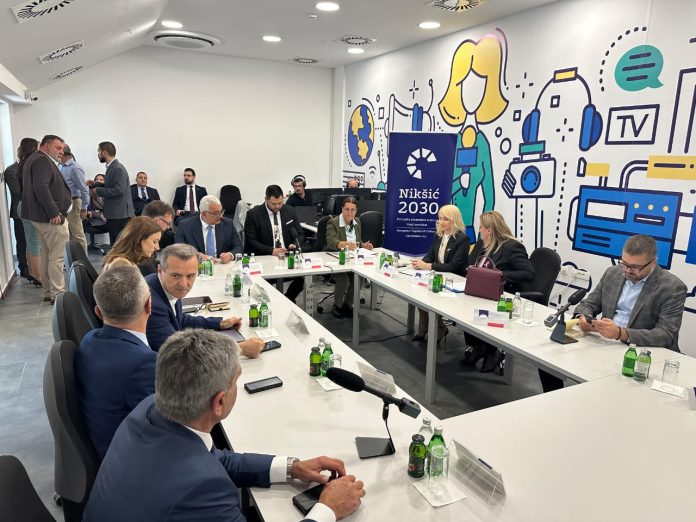
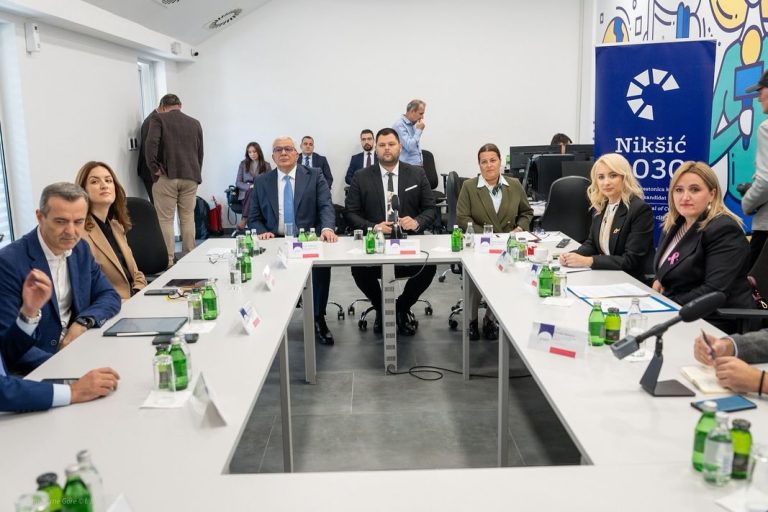
She participated today in a roundtable on Nikšić’s candidacy for European Capital of Culture 2030, hosted by the Mayor of Nikšić, Marko Kovačević.

Numerous state officials from Montenegro attended the meeting to support Nikšić in the competition for this prestigious title, while representatives of the European Commission joined the discussion via video link.
Participants discussed the topic “Capacity for the Implementation of the Nikšić 2030 Project — European Capital of Culture — Political, Institutional, and Financial Sustainability and National Relevance of the Project,” aimed at demonstrating the political, institutional, and infrastructural sustainability of this important initiative.
The roundtable included:
Andrija Mandić, President of the Parliament of Montenegro
Budimir Aleksić, Deputy Prime Minister for Education, Science, and Religious Affairs
Maida Gorčević, Minister of European Affairs
Tamara Vujović, Minister of Culture and Media
Milena Pejović Eraković, Advisor to the President of Montenegro for Culture and Protocol
Vladimir Božović, Rector of the University of Montenegro
Milutin Đukanović, Chairman of the Board of EPCG
Ivan Bulatović, Executive Director of EPCG
Milica Lalatović Žižić, President of the Nikšić Municipal Assembly
Miljan Mijušković, Advisor to the Mayor of Nikšić
Đorđije Malović, Director of the Innovation and Entrepreneurship Center “Tehnopolis”
Gorčević emphasized that Nikšić, as the birthplace of prominent cultural figures, with a century-long theatrical tradition and a lively contemporary cultural scene at the Montenegrin, regional, and European levels, deserves the status of European Capital of Culture.
“Therefore, this candidacy and the ‘Nikšić 2030’ project go far beyond a cultural initiative. It symbolizes Montenegro’s path toward full EU membership, which we have the opportunity to achieve as early as 2028. As a Capital of Culture, Nikšić would further affirm our European identity and become a platform for presenting the new member state to Europe, and Europe to Montenegro,” said the Minister.
European Commission representatives were presented with a showcase of planned infrastructure projects within the Nikšić 2030 — European Capital of Culture initiative, as well as the city’s most significant cultural and historical landmarks, including the Cathedral of St. Basil of Ostrog, King Nikola’s Palace, and the Bedem Fortress, which Montenegrin officials also toured.
MINISTRY OF EUROPEAN AFFAIRS