



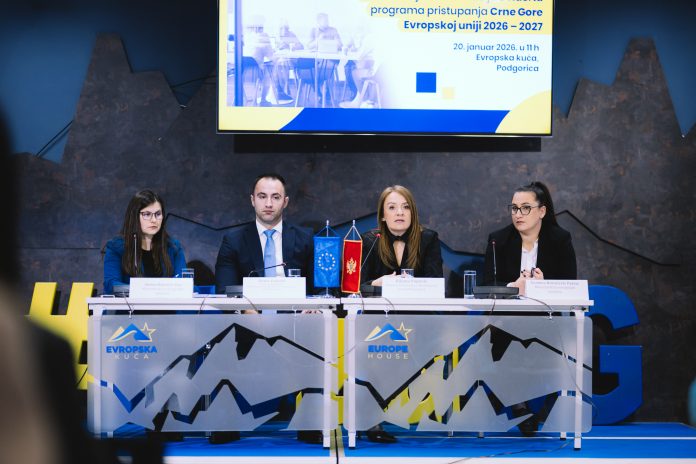

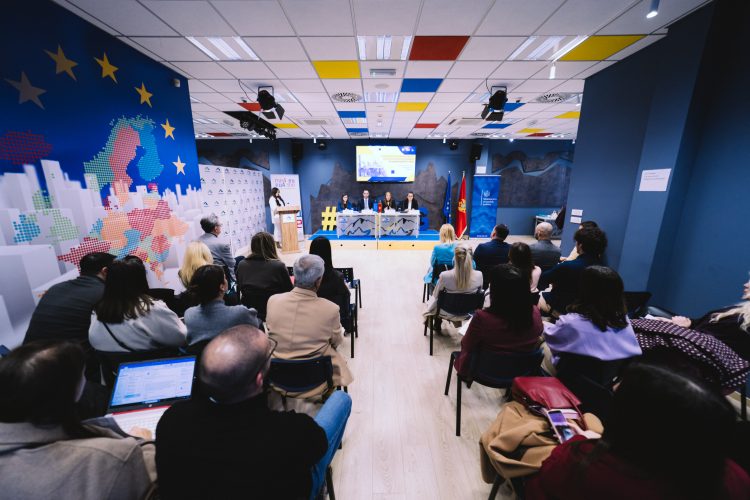
The Ministry of European Affairs organized today a presentation and consultations on the Draft Programme for Montenegro’s Accession to the European Union 2026–2027.
The meeting, attended by representatives of the Committee on European Integration of the Parliament of Montenegro, members of the negotiating structure, and non-governmental organizations, provided an opportunity for the exchange of views with the aim of finalizing this strategic document as effectively as possible.

The document was presented by State Secretary at the Ministry of European Affairs Biljana Papović, Acting Director General of the Directorate for Montenegro’s Accession to the European Union and the EU acquis Denis Vukotić, and Head of the Agriculture and Fisheries Unit at the Ministry of European Affairs Granica Kovačević Petrić.
State Secretary Papović explained that the Accession Programme represents the most important strategic document in the negotiating process and that it covers obligations for 2026 and 2027. She further noted that, in line with previous practice, Montenegro faces a large number of obligations within the document itself, but that it is necessary to make a clear distinction between those arising from closing benchmarks, i.e. the closing of negotiating chapters. She emphasized that precisely these obligations are the priority of the Government and the negotiating structure in the first two quarters of 2026, when the deadline for their implementation is foreseen, all with the aim of closing all negotiating chapters by the end of 2026.
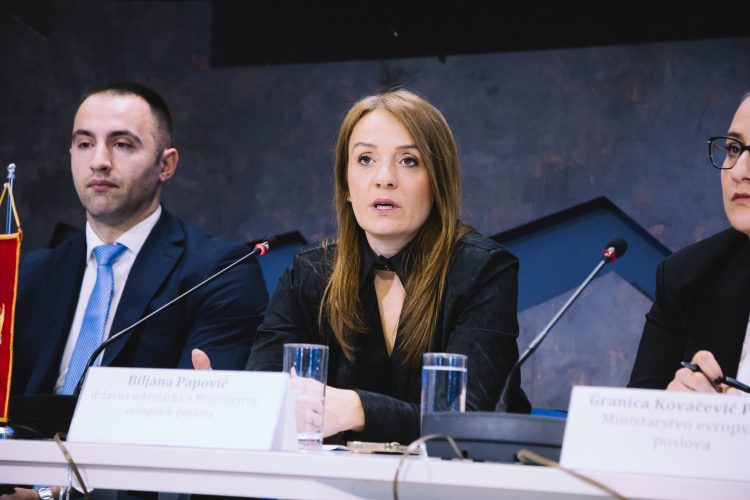
In this regard, she stated that out of a total of 564 acts, of which 490 are planned for 2026, 122 obligations are directly related to the fulfilment of benchmarks and the closing of chapters, namely 22 strategic acts, 48 laws, and 52 by-laws. She also emphasized that this Programme of Accession of Montenegro (PPCG), including visually, sought to highlight the obligations that constitute a condition for closing chapters, and these are marked in blue.
She stressed that it is extremely important for Montenegro to complete the negotiating process by the end of 2026, pointing out that deadlines are short and, bearing in mind the importance of the role and activities of civil society in the EU accession process, invited representatives of non-governmental organizations to get involved and contribute so that the work can be completed with quality and on time.
Acting Director General Denis Vukotić stated that the PPCG represents a key strategic document of European integration, defining the scope and dynamics of reforms necessary for alignment with the European Union acquis, and that, due to the continuous development of the EU acquis, it is updated on an annual basis in order to reflect the latest changes and ensure alignment of national legislation with European standards.
He explained that the drafting of the PPCG began during the fourth quarter of 2025, with the aim of aligning the document with the new EU acquis from the period 1 October 2024 to 31 October 2025, as well as with the dynamics of adopting national legislative and strategic documents necessary for finalizing accession negotiations by the end of 2026.
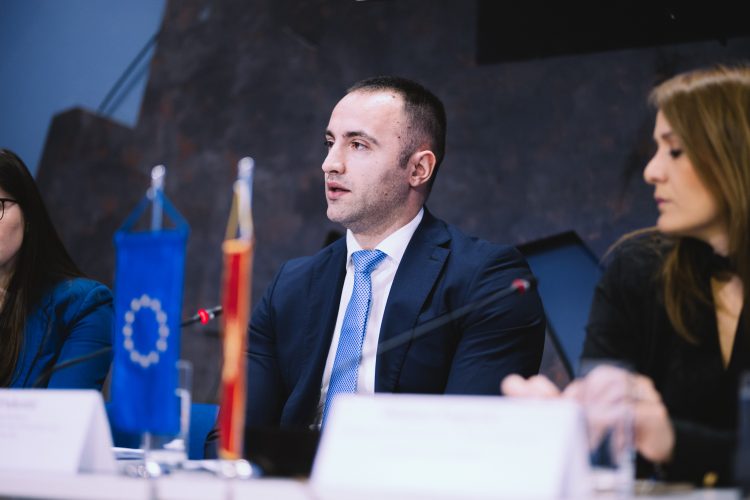
“The preparation of the Programme for Montenegro’s Accession to the European Union for the period 2026–2027 entailed a detailed analysis of 2,625 European Union acts, whereby relevant regulations transposed into the national legal order were translated into planned obligations contained in the Programme. The Programme is designed to clearly distinguish activities that represent an immediate precondition for closing negotiating chapters from those implemented within the regular process of further alignment with the European Union acquis. Activities of key importance for closing chapters are planned in the first two quarters of the year, in line with the practice of the European Commission according to which all obligations must be fulfilled at least four months before the planned closing of negotiating chapters,” Vukotić said.
The Head of the Agriculture and Fisheries Unit at the Ministry of European Affairs, Granica Kovačević Petrić, presented the statistical aspect of the document, pointing to the scope of obligations within the strategic and legislative framework by years, with a particular focus on negotiating chapters and institutions with the largest number of planned obligations. In this context, she highlighted that under the Draft PPCG the largest number of obligations is planned in six negotiating chapters: Chapter 14 – Transport Policy (81 obligations); Chapter 12 – Food Safety, Veterinary and Phytosanitary Policy (80 obligations); Chapter 1 – Free Movement of Goods and Chapter 13 with the same number of obligations (55 obligations); Chapter 27 – Environment and Climate Change (37 obligations); and Chapter 23 – Judiciary and Fundamental Rights (28 obligations).
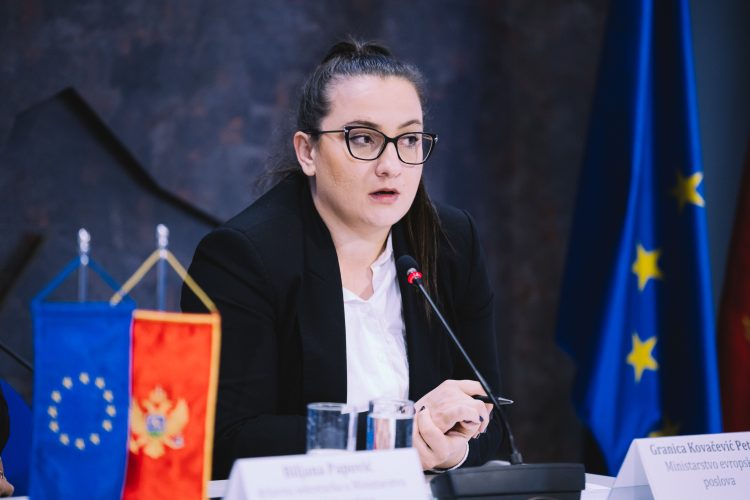
She emphasized that the largest number of obligations was planned by the Ministry of Agriculture, Forestry and Water Management – 94 obligations; the Administration for Food Safety, Veterinary and Phytosanitary Affairs – 80 obligations; the Ministry of Finance – 62 obligations; the Ministry of Ecology, Sustainable Development and Northern Region Development – 41 obligations; the Ministry of Economic Development – 38 obligations; and the Ministry of Transport – 36 obligations.

During the discussion, representatives of the civil sector showed interest in an overview of the level of fulfilment of obligations in the previous year. They also expressed interest in the adoption of acts under urgent procedure, issues related to constitutional amendments, as well as issues of gender identity based on self-determination.
MINISTRY OF EUROPEAN AFFAIRS