



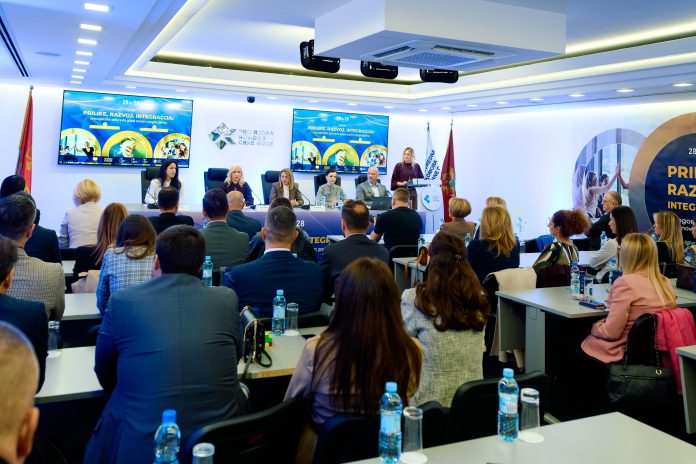

Ahead of the closure of Chapters 3 (Right of Establishment and Freedom to Provide Services), 4 (Free Movement of Capital), and 6 (Company Law), the Ministry of European Affairs, Chamber of Commerce of Montenegro, Ministry of Economic Development, and Ministry of Finance, with support from the European Union Delegation through the EU4ME project, organized a panel debate titled “OPPORTUNITIES. DEVELOPMENT. INTEGRATION: Montenegrin Economy Ahead of New Chapters.”

Opening the event, the Minister of European Affairs, Maida Gorčević, said that by closing the chapters, we show that Montenegro is not only harmonizing regulations but also building an economy compatible with Europe and ready for equal participation in the EU Single Market.

“Closing these three chapters means easier business start-ups, removal of unnecessary administrative barriers, and greater competition — but also more opportunities to offer your services across the EU. It also means clearer rules, less risk, a more stable financial system, and greater predictability for investors. This process also brings uniform and modern business regulations and fair conditions for all,” said Gorčević.

The President of the Chamber of Commerce of Montenegro, Nina Drakić, said that the Chamber was an active partner in this process, which confirmed that involving the business community in preparing analyses, drafting legislation, and consultations is essential for long-term stability and economic growth based on predictability, transparency, and equal rules for all.

“Today we talk about progress that not only strengthens institutions — it builds trust. Trust of investors, trust of European partners, but also trust of our economy that every new step in the negotiation process brings additional momentum to economic growth and strengthening competitiveness. And trust is perhaps the most important currency of the modern market today,” Drakić stated.

Milica Adžić, State Secretary at the Ministry of Finance, said that the EU accession process goes beyond technical negotiations, as it represents the fundamental basis of economic modernization.

“All these reforms contribute to improving the business environment, attracting investments, and confirm our commitment to European values and standards, which clearly shows that we are on the right path towards full EU membership,” said Adžić.

Panel discussions focused on the advantages and challenges of closing Chapters 3, 4, and 6.
Bojana Bošković, State Secretary at the Ministry of European Affairs and Head of the Negotiating Working Group for Chapter 4, said that Montenegro’s recent SEPA membership significantly contributes to modernizing Montenegro’s financial system, reducing barriers to accessing financial services, and supporting inclusive economic development.

“The next big step is the establishment of the Instant Payment system through the TIPS Clone project. The first phase means that Montenegro will have a domestic instant payment system — that is, transactions will be executed in less than 10 seconds, 24 hours a day, seven days a week, 365 days a year. No waiting on weekends, no waiting until tomorrow morning — the money is in the account in a few seconds,” said Bošković.
Ivona Savićević, Head of the Negotiating Working Group for Chapter 3, said that Montenegro has made significant progress in recognizing professional qualifications, particularly through alignment with the EU Directive on professional qualifications.

“This legal framework was created to recognize seven key professions that have the greatest mobility within the EU, and these seven professions are recognized as those that most frequently cross EU borders, and therefore alignment with EU standards regarding their recognition is crucial for strengthening labor mobility and facilitating access to the EU market,” said Savićević.
Renata Milutinović, Head of the Negotiating Working Group for Chapter 6, said that Montenegro, by adopting all legislative solutions required by the closing benchmarks, has created the foundations of a modern and EU-aligned economy in this chapter.

“The framework for company establishment, management, and transparency has been improved, protection of minority shareholders has been strengthened, the business registration system has been digitalized, accounting and auditing standards have been enhanced, and institutional capacities have been strengthened. This strengthens the business environment, legal certainty, and investor confidence, which represents an important step for our entrepreneurs and SMEs, as well as for the overall economic development of the country,” said Milutinović.
Tomislav Njegovan from the Croatian Chamber of Commerce shared the experience of Croatia as an EU member. He explained that Croatia had a number of inherited challenges during negotiations with the EU, especially in the areas of state-owned enterprises, public procurement, subsidies, and competition.

“The internal market provides access to modern technologies and knowledge that should be utilized in order to become competitive. On this market, you will succeed to the extent that you are competitive,” said Njegovan.

From a legal perspective, Dijana Raičković, former judge of the Commercial and Appellate Court, emphasized that adopting European standards does not only mean passing laws but also their consistent implementation to ensure legal certainty.

Speaking on behalf of the business community, Tomo Knežević from TiM Consulting emphasized that closing Chapter 3 gives small entrepreneurs the opportunity to engage in cross-border projects together with larger companies and use EU funds. However, he noted that the key challenge remains the awareness and education of entrepreneurs.

From the perspective of larger business systems, Ljudmila Popović Kavaja from the company One, which already operates in accordance with EU standards, explained that closing Chapter 6 should bring a business environment that foreign investors expect — security, simplicity of operations, and clear rules, without additional challenges.
Ministry of European Affairs