



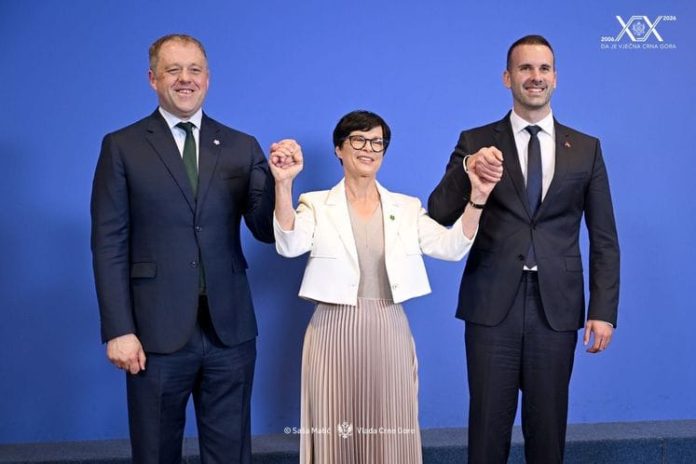

Today, at the Intergovernmental Accession Conference in Brussels, Montenegro closed two negotiating chapters: Chapter 8 – Competition and Chapter 29 – Customs Union, bringing the total number of chapters closed in the negotiating process so far to 18.
Addressing the participants of the conference, Prime Minister Milojko Spajić stressed that Montenegro is once again confirming that the reform process is delivering concrete results and that our country continues to make progress towards full membership of the European Union.
He said that Montenegro’s European path has never been a competition with others, but above all a competition with its own standards.
“Success has never come from competing with neighbours or other candidate countries. It has come from competing with ourselves – raising standards, strengthening institutions and constantly asking what more we can do to reach European values,” Spajić stressed.
The Prime Minister stressed that today’s closing of the chapters confirms that Montenegro is building institutions capable of protecting competition, ensuring a fair market and safeguarding the external borders of the European Union in line with common European rules.
Speaking about the importance of the enlargement process, the Prime Minister said that it now has a much broader significance than the mere admission of new members.
“Enlargement today is no longer just a matter of expanding the borders of the European Union. It means strengthening Europe itself – its competitiveness, resilience, economic security and the integrity of the Single Market,” Spajić stressed.
The Prime Minister recalled that reforms in the areas of competition policy and the customs union required responsible and often difficult decisions, but that such decisions are precisely the foundation of Montenegro’s European path.
“European competition policy is not designed to protect individual companies. Its purpose is to protect fair competition. Montenegro has shown that it is ready to take the decisions necessary to preserve that principle,” Spajić said.
Speaking about customs policy, the Prime Minister stressed that Montenegro has transformed from a system once associated with smuggling into a modern customs administration that meets all European standards and is ready to protect the external borders of the European Union.
The Chair, Irish Minister of State for European Affairs Thomas Byrne, congratulated Montenegro on the progress achieved, adding that accession negotiations advance exclusively on the basis of results achieved.
As he said, the closure of more than half of the negotiating chapters is an important milestone not only for Montenegro and the European Union, but also for every citizen in the candidate countries who wants their country to become a member of the European Union.
Minister Byrne stressed that this demonstrates that the Council is preparing the ground for the accession of a new Member State and that enlargement is a real process.
European Commissioner for Enlargement Marta Kos said that, with today’s Intergovernmental Conference, Montenegro is continuing to make progress in the negotiations, and that 18 closed chapters represent a significant achievement.
As she stressed, while the Council continues its work on Montenegro’s accession treaty, the European Commission has presented a proposal for a financial framework establishing the budgetary arrangement for Montenegro after accession.
The Commissioner said that these steps represent an important milestone on Montenegro’s path towards full membership of the European Union.
She welcomed the launch of the process of constitutional amendments in Parliament, which is leading towards the completion of the constitutional reform process.
In his closing remarks, the Prime Minister stressed that the closing of chapters is not the end of the reform process, but confirmation that reforms are delivering results.
“And that a merit-based enlargement policy works when commitment is accompanied by partnership,” Spajić said.
Prime Minister Spajić said that Montenegro remains fully committed to completing the negotiations, continuing reforms and strengthening the rule of law, with the conviction that Montenegro’s membership represents a contribution not only to our country, but also to a stronger and more resilient European Union.
“Montenegro is not joining the European Union merely as a new Member State. Our European choice confirms that common values, democracy, the rule of law and human dignity remain the strongest foundation of the European project,” the Prime Minister concluded.
Source: gov.me