



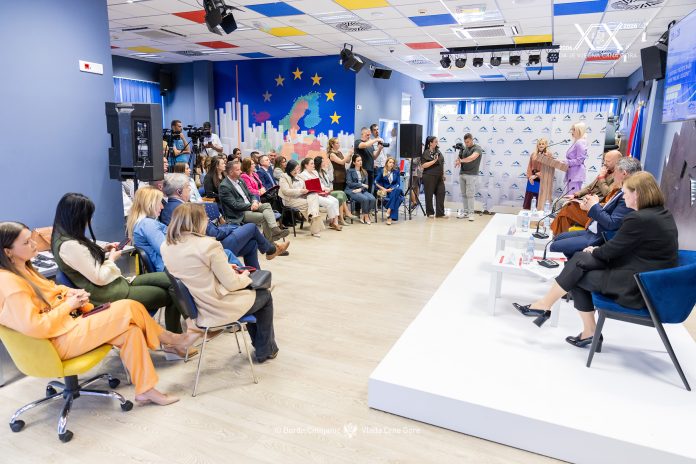

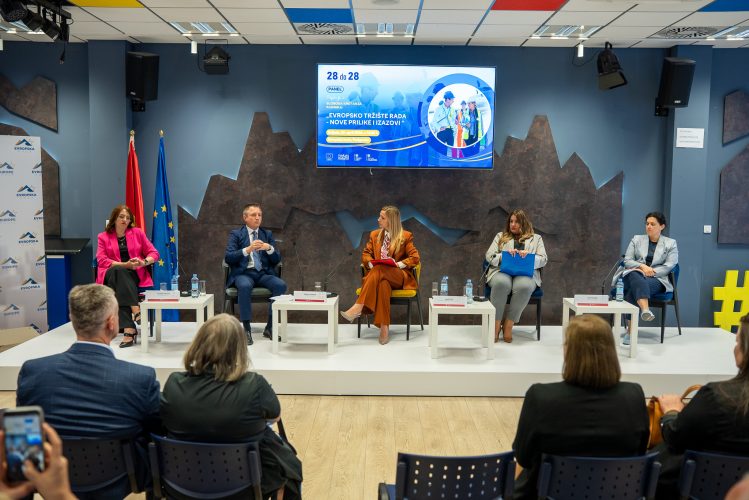
Chapter 2: Free Movement of Workers brings more rights, greater security and less uncertainty for citizens through stronger protection and equality of workers, regardless of where they work. It establishes clear rules applicable across all EU Member States, rules that citizens can rely on, without distinction between domestic and foreign workers. This was the key message delivered at the panel “European Labour Market – New Opportunities and Challenges”, organised by the Ministry of European Affairs and the Ministry of Labour, Employment and Social Dialogue, with the support of the European Union through the EU4ME project, as part of the “28to28” campaign, ahead of the expected closure of this chapter at the end of May at the Intergovernmental Conference.
Minister of European Affairs Maida Gorčević emphasised that Chapter 2 covers policies that directly shape citizens’ everyday lives, from employment and the labour market to the protection of workers’ rights and social security.
“Chapter 2 regulates the right of citizens to work anywhere within the European Union, without discrimination based on nationality. I would like to emphasise that EU citizens are equal, and when I say this, I am not referring only in terms of values, but also to clearly established rules that are consistently applied,” said Gorčević.

Minister Naida Nišić stated that Chapter 2 represents the foundation of the European labour market and brings broader opportunities for both citizens and employers.
“Through negotiations within the framework of free movement of workers, Montenegro’s labour market is enabled to connect more effectively with the single European space, where knowledge, skills and experience can freely circulate to where they are most needed. In this way, not only is the competitiveness of the economy improved, but innovation, productivity and sustainable economic growth are also encouraged,” said Nišić.

At the panel “Freedom. Employment. Integration – What Does Chapter 2 Bring?”, participants discussed the impact of free movement of workers on the labour market and the rights accompanying labour mobility. Ivana Šućur, Head of the Working Group for Chapter 2 from the Ministry of Labour, Employment and Social Dialogue, stated that Montenegro is in the final stage of preparations for closing this chapter. Speaking about key reforms, Šućur noted that the European Commission has clearly defined the final benchmark for closing the chapter.
“Montenegro must demonstrate that it has adequate structures and capacities for the full and proper implementation of the European Union acquis in the area of free movement of workers. Montenegro is expected to ensure full operational capacity of key systems such as EESSI, EURES and EHIC, as well as strengthened labour inspection services, which implies effective functioning in practice and daily use by institutions and citizens. Particular emphasis is placed on establishing reliable and interoperable IT infrastructure that is fully aligned,” explained Šućur.
Dragan Dašić from the Ministry of Interior spoke about amendments to the Law on Foreigners as an important step in harmonising with EU standards. He particularly highlighted that, through the amendments adopted last year, EU Directive 2004/38/EC was fully and systematically transposed into national legislation.

“Through this law, EU citizens and their family members are equalised in rights with Montenegrin citizens, including the right to work and self-employment,” said Dašić.
The experience of an EU Member State was shared by Ivana Ružman, a labour market expert from Croatia, who pointed out that opening the labour market brought more employment opportunities and strengthened labour standards, but also challenges such as workforce outflow and shortages of qualified workers. She stressed that initial transitional restrictions in some Member States were temporary and that full free movement of workers gradually led to greater mobility and integration within the European labour market.
“Croatia’s accession to the EU in 2013 marked the beginning of the transformation of the labour market. Croatia moved from a relatively closed labour market to an open, competitive European system, bringing significant benefits for individuals, but also challenges for the economy,” said Ružman.

The second panel, focused on institutional readiness, featured Gordana Vukčević from the Employment Agency of Montenegro, who highlighted obligations within the EURES network and the strengthening of links with the European labour market.
“Joining the EURES network will bring multiple benefits. First and foremost, it will provide citizens with better access to employment opportunities abroad, supported by reliable and verified information. At the same time, employers will have the opportunity to find qualified workforce from the wider European environment. Through EURES, institutional cooperation will also be strengthened, data exchange improved, and national labour markets aligned with European standards. In this way, EURES represents an important instrument for improving labour mobility, reducing unemployment and strengthening the overall competitiveness of the labour market,” explained Vukčević.
Vladimir Drobnjak, Acting Director of the Pension and Disability Insurance Fund, explained that the essence of social security system coordination lies in ensuring continuity and protection of the rights of citizens moving within the European Union, through the alignment of national systems with EU rules.
“Coordination of social security systems refers to a set of rules that harmonise national social protection systems with European Union regulations in order to ensure the rights of citizens moving within the EU. This coordination covers rights such as pensions, health insurance, unemployment benefits, family benefits, sick leave and disability benefits,” explained Drobnjak.

Vinka Vukeljić from the Health Insurance Fund spoke about the introduction of the European Health Insurance Card and improving access to healthcare within the EU.
“The European Health Insurance Card (EHIC) is a document issued to insured persons from EU Member States and is valid throughout the European Union and the European Economic Area. It enables easier access to necessary healthcare during stays in other countries, under the same conditions as for domestic insured persons. By introducing this card, which replaces existing forms, the efficiency of the system is improved through the development of digital solutions and faster data exchange, ensuring citizens have safer, more transparent and simpler access to healthcare services abroad, without additional procedures and uncertainty,” said Vukeljić.

Labour inspector Darka Radulović highlighted labour inspection reforms and the importance of strengthening control mechanisms in the EU accession process.
“Labour inspection ensures supervision over the implementation of labour regulations, including the protection of workers’ rights, monitoring working conditions and preventing discrimination. Through the Action Plan for the period 2025–2027, Montenegro is implementing systematic strengthening of its capacities through the employment of additional inspectors, improved cooperation with institutions and international partners, as well as the development of a Unified Inspection Information System and digital tools for reporting irregularities. These measures should ensure more effective supervision and greater protection of workers’ rights in practice, alongside consistent application of regulations and increased security for citizens,” explained Radulović.

The panel was organised within the “28 to 28” campaign, which aims to bring the benefits and challenges of the negotiation process closer to citizens. Montenegro has so far closed 14 chapters, and by the end of May the closure of at least two more chapters is expected, including Chapter 2.