




Airports of Montenegro AD Podgorica and Port of Kotor AD for years have been actively participating in international initiatives that promote accessibility and inclusiveness in the transport sector. Their participation in the projects “DANOVA” and “DANOVA NEXT” is a significant contribution to modernization of transport infrastructure in Montenegro and alignment with European standards in the field of travelling for persons of impaired hearing or sight, and reduced mobility. Both projects are implemented within the Danube Region Programme that encourages transnational cooperation and sustainable development of the Danube region.
Project “DANOVA” – Innovative transport services for persons with partly or fully impaired sight in the Danube region” was implemented within the financial perspective 2014-2020 in the period 1 July 2020 – 31 December 2022. The total budget of the project amounted to 2,192,546.66 euro, out of which Montenegrin partners got more than 200,000.00 euros. The aim of the project was to improve accessibility of airports and other transport nods for persons with full or partial sight impairment. The project achieved significant and concrete results in improving physical and digital accessibility. The included providers of transport services acquired new knowledge, competences and tools.
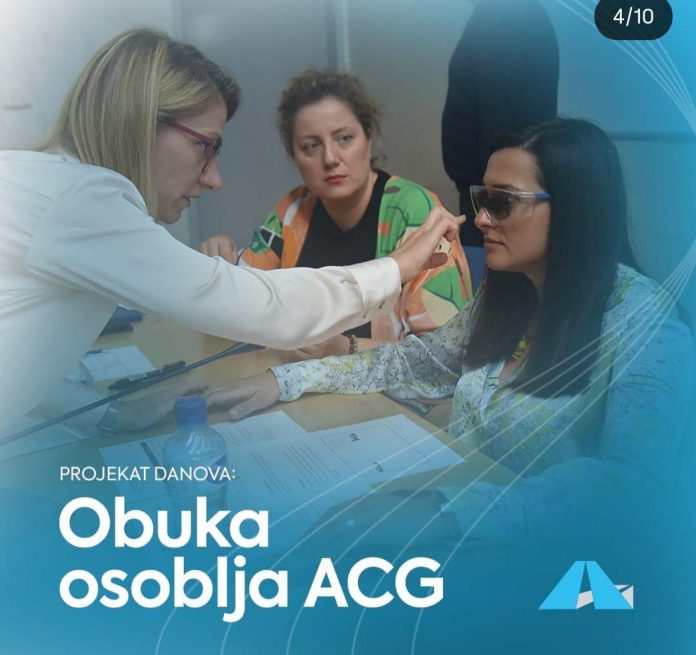
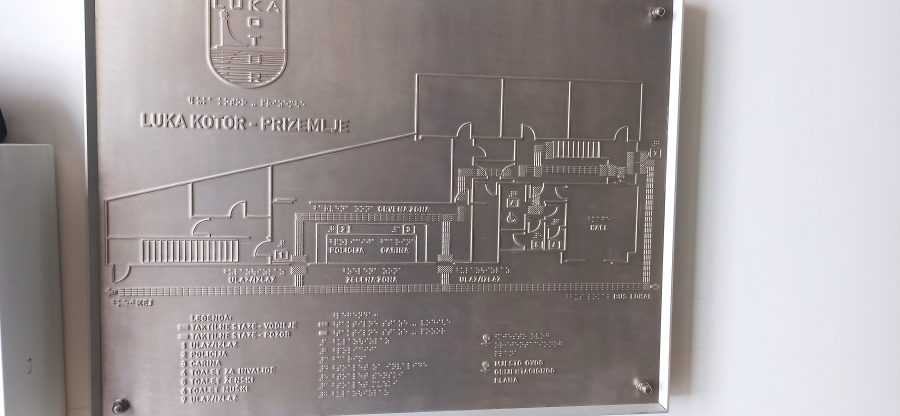
Within the DANOVA project, “Port of Kotor” AD Kotor successfully implemented several infrastructural interventions: 450m of tactile guidance paths in the contact zone from the border zone of the port of Kotor to the bus station across the Kotor open market; internal tactile-contrast lanes have been installed in the passenger terminal of the port of Kotor; 2 orientation plans for persons with sight impairment have been developed; signs in Braille alphabet have been installed within the passenger terminal of the port of Kotor. Key partner in the training of staff was the NGO Association of the Blind of Montenegro that implemented trainings for proper communication and assistance.
Airports Podgorica and Tivat have also successfully implemented a number of measures for accessibility: more than 200 m of tactile paths and tactile walking surface indicators, 77 local microphones (30 in Podgorica, 47 in Tivat), contrast lanes in accessible toilettes, video wall in the central hall of the terminal, orientation plan and 58 stickers in Braille alphabet. Accessibility of the official web site for persons with partial sight impairment has also been enhanced.
Coordinator of the Project in the Airports of Montenegro, Nina Leković, particularly emphasizes the following: “We used to have almost no accessibility elements and today we can proudly speak about the environment that ensures free and independent movement, allowing passengers with sight impairment to use airport services in equal conditions like all other passengers. The users responded positively to the results of the project, because the solutions were developed based on their real experience and situations that they face when using the airport services. A particular value that this project has brought is the strengthening of cooperation with the organizations that advocate the rights of persons will full or partial sight impairment. Through direct consultations, we got precious feedback that shaped the solutions implemented in the airports.”
The achieved results and successful cooperation led to continuation of the project in the new financial perspective 2021-2027. The Project “DANOVA NEXT” – Smart transport network for accessibility for passengers with disability and reduced mobility in the Danube region through innovative services” extended the field of activities to the persons with hearing impairment and persons with reduced mobility. This project started on 1 January 2024 and will end on 30 June 2026. The total budget amounts to 2,622,400.00 euros, out of which the amount of 325,000.00 euros is available to Montenegrin partners.
The project DANOVA NEXT connects air, maritime and urban transport, demanding a more integrated approach and cooperation between different sectors of transport, local self-governments and civil society.
The Airports of Montenegro plan to use project funds for: instalment of an induction loop at the info desk which is at the same time a meeting point and assistance point for persons with disabilities and reduced mobility; purchase of two electric vehicles for transport of passengers with disability and reduced mobility on the path between aircrafts and passenger terminal; purchase of non-metal wheelchairs for easier security control; instalment of an accessible lost and found counter. The project also includes integration of new solutions with already installed tactile paths, as well as development of DANOVA NEXT web application that will provide accessible information in real time.
According to the project coordinator from the Airports of Montenegro, Jelena Krklješ: “Although the project is still in progress, the user and target groups feedback that we have received so far is very good and confirms that the approach based on real experience of persons with disabilities produces the most precise and the most useful results. When I say that the user and target groups feedback is positive, I do not think that we get only praises. The quality of feedback is measured by response, openness and willingness of the users to provide concrete advice, criticism and proposals. It is precisely that type of communication that contributes the most to development of practical and feasible solutions. Every time when we get a constructive comment, we take it as a sign that users believe in the process and that they want us to improve accessibility together.”
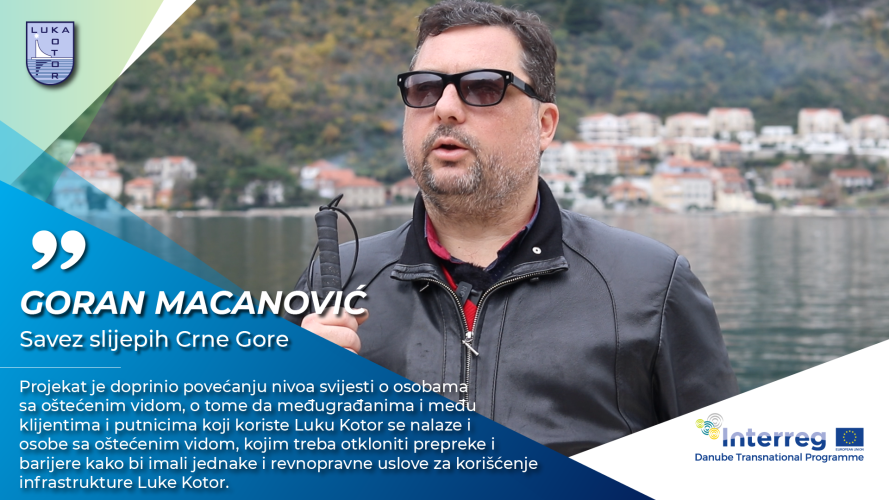
Within the DANOVA NEXT project, the Port of Kotor introduced additional accessible solutions: the induction loop for customs and police points in the passenger terminal of the Port of Kotor; two electric vehicles for assisting persons with reduced mobility; three non-metal wheelchairs for easier transport through the border zone; development of application for assisting persons with disabilities in the port. According to the coordinator Maja Danilović, “In addition to working on the goals of the project that were focused on installing the equipment for adjustment to persons with disabilities, our company had the experience of cooperating with the focus group which is exceptionally valuable and irreplaceable. With the support of the Association of the Blind of Montenegro and NGO Imi Boke, we learned how to adjust our approach and treatment of persons with disabilities and how to make their experience in the Port of Kotor more pleasant.”
Diversity of the project consortiums in both of these projects ensured that, together, they can develop the solutions that go beyond the borders of one state or one category of users. The project partners include: Airport of Dubrovnik (Croatia) as the leading partner in the project, Airport Budapest (Hungary), International Airport of Sarajevo (Bosnia and Herzegovina), International Airport Chișinău (Moldova), Port Administration Pula (Croatia), and other partners from public transport, local self-governments, academic community and non-governmental sector from various countries of the Danube region which includes Slovenia, Czech Republic, Austria, Slovakia, Romania, Bulgaria.
Joint strategic partner in the project is the Ministry of Transport of Montenegro (previously Ministry of Capital Investment). The Ministry supported projects through participation in workshops, expert suggestions, and dissemination of information to relevant institutions, which increased visibility of the project and facilitated cooperation with users organizations.
According to the opinions of the project partners, the most important value of the DANOVA projects is the fact that cooperation results in solutions that influence passenger experience on a daily basis. As the representatives of the partner organizations say: “DANOVA and DANOVA NEXT have shown that the European calls and the Danube programme do not only constitute a framework for financing, but also the space where real and vivid cooperation takes place. Through this programme, we have had the opportunity to learn about the approaches, solutions and practices that we could otherwise not get, and to compare them with our own experience and daily work. It is also important that the exchange of experience has never been a mere formality. It is actually one of the most beautiful parts of the process. Through the project, we learned about solutions and approaches we did not have an insight into earlier, but at the same time we got the opportunity to share our own experience. In that way, cooperation developed between partner organizations has become much more than an obligation within the project. It built trust and professional links that last, and that encourage us to support each other in future initiatives too.”
By: Bojana Popadić, Ministry of European Affairs
This text was published in the 17th issue of Eurokaz magazine.