



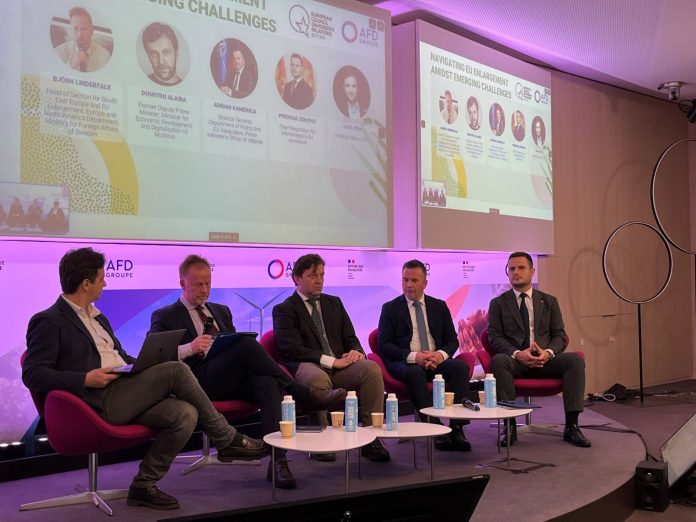

Montenegro’s Chief Negotiator with the European Union, Predrag Zenović, visited Paris from 9 to 11 December to participate in the international conference “Larger, Safer Europe: How to Get EU Enlargement Right,” organized by the European Council on Foreign Relations (ECFR) and the Agence Française de Développement. During his visit, Zenović also held a series of significant bilateral and expert meetings with key French and European institutions.
At a panel focused on the challenges and dynamics of the EU enlargement process, Zenović emphasized that accelerating European integration must go hand in hand with maintaining high-quality reforms — particularly in the areas of rule of law, institutional resilience, and the functionality of democratic institutions. He stressed that the EU accession process, especially in the context of modern security challenges, remains the most important instrument for long-term stability, political and economic convergence, and comprehensive societal transformation in candidate countries.
Zenović reminded participants that Montenegro strongly advocates merit-based accession, with clear and measurable criteria, stronger pre-accession support mechanisms, and gradual integration of candidates into EU policies and instruments before full membership. He also highlighted that closing the next five negotiation chapters would allow Montenegro to reach the critical mass necessary to start technical preparations for drafting the EU Accession Treaty.
During his stay in Paris, Zenović held working meetings at the French General Secretariat for European Affairs and in the Office of the President of France. Discussions focused on France’s role in the future enlargement process, strengthening Europe’s security architecture, and supporting Montenegro’s reform efforts in the final phase of accession negotiations.
Zenović also participated in a lecture at the Jacques Delors Institute, exchanging views with leading European experts on EU enlargement prospects, the situation in the Western Balkans, and the link between enlargement and the EU’s internal reforms. Meetings were also held with responsible directors and officials for European Affairs and the Western Balkans at the French Ministry for Europe and Foreign Affairs.
Montenegro’s active participation in strategic European debates and ongoing dialogue with key EU member states demonstrates the country’s clear political commitment to the European path and its constructive role in shaping the future of EU enlargement policy.