



Naslovnica Chapter 31 – Foreign, security, and defence policy
Chapter 31 – Foreign, security, and defence policy
What is being negotiated?
In line with Montenegro’s foreign policy priorities regarding full EU and NATO membership, Chapter 31 covers:
-
Political dialogue with the EU,
-
Issues related to the candidate country’s relations with the EU and its institutions,
-
Cooperation with international organizations, particularly the UN, OSCE, and Council of Europe,
-
A developed arms control system,
-
European security and defense policy,
-
Cooperation with NATO, and
-
The fight against terrorism.
Areas and sub-areas
The acquis for Chapter 31 can be divided into two areas:
-
European Political Cooperation
-
Common Foreign and Security Policy (CFSP) and Common Security and Defence Policy (CSDP)
Common Foreign and Security Policy (CFSP) and Common Security and Defence Policy (CSDP)
-
CFSP is an organized and agreed EU foreign policy focused on security and defense. It covers certain aspects of the EU’s external relations, mainly including trade and commercial policy, but also other areas such as financial assistance to third countries and related matters.
-
CSDP is the main component of the EU’s CFSP and covers defense and military aspects. The EU participates in civilian and military missions and operations worldwide.
Political dialogue with the EU
This area addresses the candidate country’s relations with the EU and its institutions, including:
-
Participation in joint EU-Montenegro bodies,
-
Accession to EU declarations and conventions.
Cooperation with international organizations
This area focuses on the candidate country’s collaboration with international organizations.
-
United Nations (UN): Montenegro became the 192nd member on 28 June 2006 and actively contributes to UN goals such as promoting international cooperation, preserving international peace and security, developing friendly relations among states, protecting human rights and freedoms, and providing humanitarian assistance.
-
Council of Europe (CoE): Montenegro became the 47th full member on 11 May 2007. The CoE promotes human rights, democracy, and the rule of law through shared democratic principles based on the European Convention on Human Rights and other international instruments.
Arms control
Montenegro is a signatory to numerous arms control documents. As an EU candidate country, it must have a developed arms control system based on an EU-aligned regulatory framework.
-
Control over foreign trade in weapons, military equipment, and dual-use goods involves several state institutions.
-
Their combined efforts implement the legal framework, customs control, public awareness, and criminal enforcement in case of violations.
European security and defense policy
This area regulates the candidate country’s participation in missions and defense-related institutions of EU interest.
-
Montenegro participates in international peacekeeping missions, contributing to global peace and security.
-
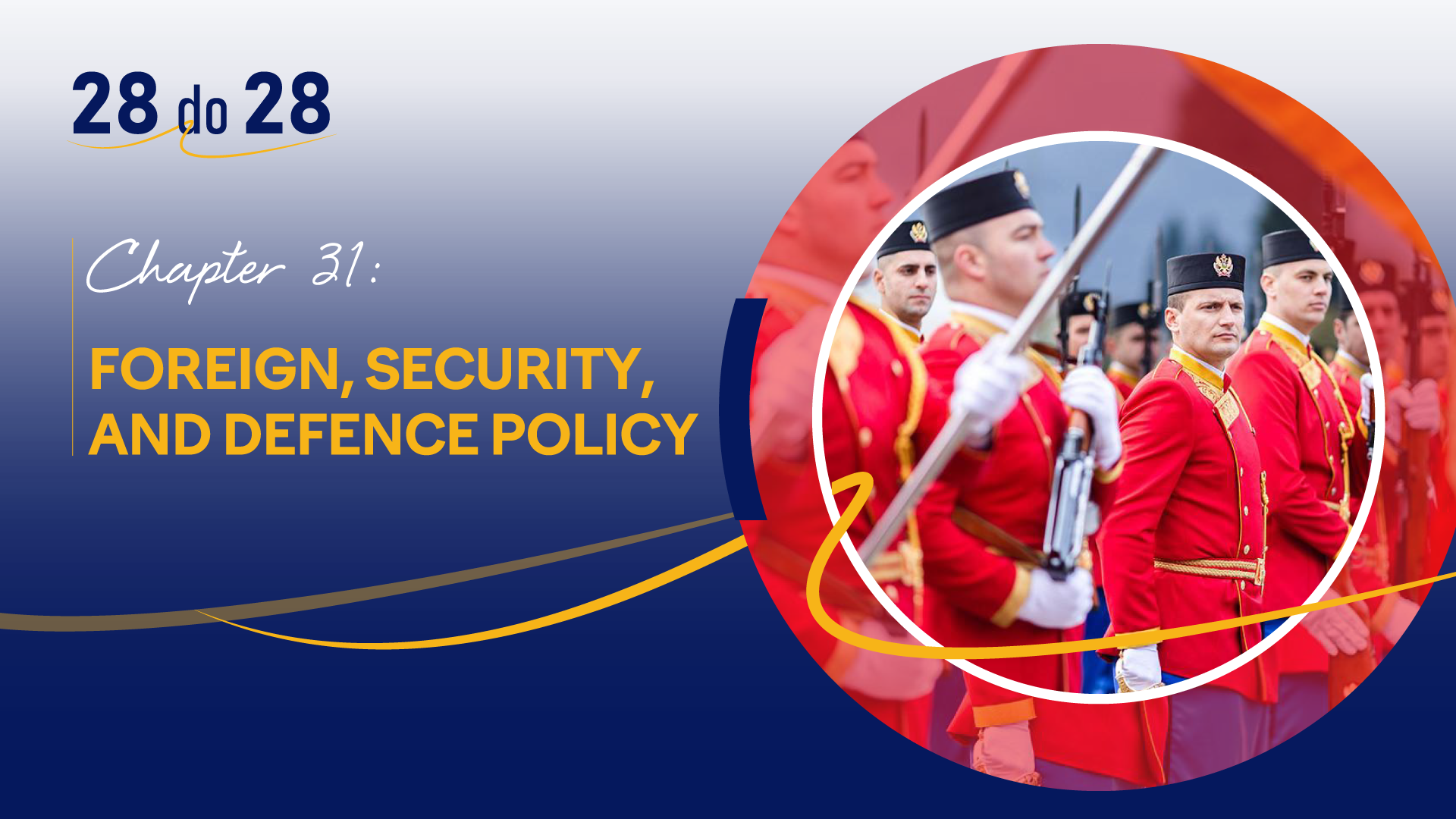
Montenegrin Armed Forces are involved in:
-
EU NAVFOR ATALANTA in Somalia
-
UN MINURSO mission in Western Sahara
-
-
Beyond UN missions, Montenegro participates in NATO missions, operations, and activities as a credible and reliable ally.
-
On 23 May 2019, Montenegro officially joined the European Centre of Excellence for Countering Hybrid Threats in Helsinki through a letter of intent, enabling experience and best practice exchange with NATO and EU member states and supporting Montenegro’s efforts to strengthen national capacities in this area.
When was the chapter opened?
Negotiations on Chapter 31 were opened at the Intergovernmental Conference in Luxembourg on 24 June 2014.
Initial benchmarks
-
The explanatory analytical review for Chapter 31 was held on 17 May 2013, and the bilateral part on 27 June 2013 in Brussels.
-
There were no initial benchmarks defined for this chapter.
Closing benchmark
One closing benchmark has been defined:
-
As a signatory of the Rome Statute establishing the International Criminal Court (ICC), Montenegro fully aligns its position with Council Decision 2011/168/CFSP of 21 March 2011 and the EU Guidelines on agreements between Rome Statute signatories and the USA regarding conditions for surrendering persons to the Court. These complement the Council conclusions on the ICC from 30 September 2002.
-
In September 2024, Montenegro notified the USA by verbal note of its intention to terminate the bilateral agreement, meeting the conditions to close this negotiating chapter.
Benefits for Montenegro
Through activities in international organizations, Montenegro:
-
Protects and promotes its interests,
-
Strengthens its strategic position,
-
Participates in shaping global political developments, and
-
Promotes regional and broader cooperation, asserting a common presence internationally.
-
CFSP (political dialogue) and CSDP (contribution capacities) are based on legal acts, including legally binding international agreements and political documents. The acquis includes political declarations, decisions, and agreements.
-
Member states must be able to:
-
Support political dialogue under CFSP,
-
Align with EU statements,
-
Participate in EU decisions, and
-
Implement agreed sanctions and restrictive measures.
-
-
Montenegro contributes to regional cooperation through active participation in initiatives and organizations such as:
-
Berlin Process,
-
Brdo-Brijuni Process,
-
Central European Initiative (CEI),
-
Southeast European Cooperation Process (SEECP),
-
Adriatic-Ionian Initiative (JII),
-
Adriatic Charter,
-
Regional Cooperation Council (RCC),
-
Regional Asylum, Migration, and Refugee Initiative (MARRI),
-
EU macro-regional strategies (EUSAIR and EUSDR), among others.
-