



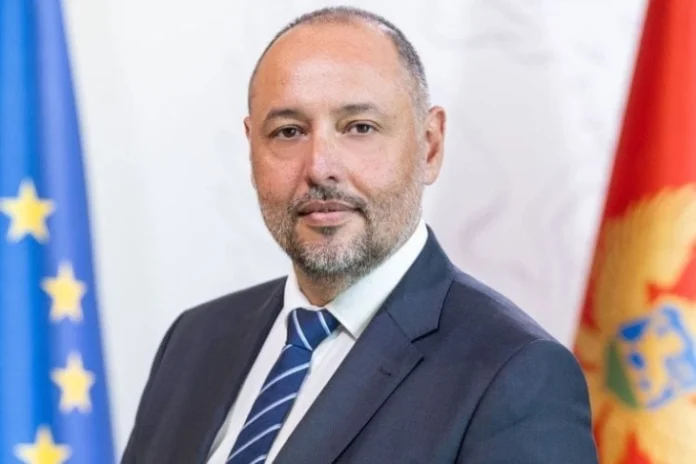

European integration in the transport sector brings stricter road rules, a more regulated railway system, greater passenger protection and better connectivity of ports and airports with European corridors, said State Secretary at the Ministry of Ecology, Sustainable Development and Northern Development Nenad Vitomirović.
“Chapter 14 covers European Union rules on road, rail, air, maritime and combined transport. The goal is to establish a safe, competitive, accessible and environmentally sustainable transport system capable of functioning as part of the single European market. Chapter 14 – Transport Policy and Chapter 21 – Trans-European Networks are part of Cluster 4 – Green Agenda and Sustainable Connectivity,” said Vitomirović, who is Head of the Working Group for Chapter 27 and Montenegro’s negotiator for Cluster 4.
As he explained, Chapter 21 establishes the infrastructure framework – roads, railway routes, ports, airports and energy networks through which Montenegro is physically connected to European corridors, while Chapter 14 regulates the rules governing the transport of people and goods on that infrastructure.
“Simply put, Chapter 21 regulates the networks connecting us with Europe, while Chapter 14 regulates the rules according to which people and goods are transported safely and efficiently along those networks,” Vitomirović said.
Vitomirović explained that, when it comes to Chapter 14, Montenegro has been working to fulfil four closing benchmarks covering alignment in road transport, railway safety and interoperability, passenger rights across all modes of transport and air traffic management.
“Our goal is not merely the formal closure of negotiating chapters, but for Montenegro to become a functional part of the European transport space – infrastructure-connected, safe, market-regulated and capable of consistently applying European standards,” Vitomirović said.
Speaking about road transport, Vitomirović noted that Chapter 14 simultaneously regulates safety and the operating conditions of professional carriers.
According to the Ministry, European rules cover driving times and mandatory rest periods for drivers, tachographs, the technical condition of vehicles, the weight and dimensions of freight and passenger vehicles, access to the profession of carrier and effective oversight of the transport market.
He assessed that the need for further improvements in safety is not in question and that it is therefore important for new legislative measures to be accompanied by consistent monitoring of their implementation.
As a significant step, Vitomirović highlighted extensive amendments to the Law on Road Traffic Safety, which entered into force at the beginning of August.
“The amendments introduce a stricter approach to behaviours that pose the greatest safety risks. Restrictions for young drivers and the participation of light electric vehicles, including electric scooters, in traffic have been specifically regulated. The implementation of the amendments is accompanied by increased police controls, particularly on heavily trafficked routes and during the tourist season,” the statement said.
Vitomirović said that the intensity of controls and the number of sanctions imposed are not a definitive measure of success.
“Results should be assessed on the basis of comparable data on the number of traffic accidents, fatalities and injuries over a sufficiently long period,” Vitomirović said.
An additional element of technical alignment is the Law on the Homologation of Vehicles, Vehicle Systems, Components and Separate Technical Units, which entered into force in the middle of the year. It improves the legal framework for verifying the compliance of vehicles and equipment with prescribed technical requirements.
“The European approach to safety entails an integrated system consisting of regulations, consistent enforcement, prevention, education of road users, safe infrastructure and data analysis. Penal policy is an important lever, but its ultimate goal must be to change the behaviour of road users and protect human lives,” Vitomirović said.
Rail transport is one of the key elements of Chapter 14 and the sustainable connectivity policy.
According to Vitomirović, a developed railway system can increase citizens’ mobility, strengthen the competitiveness of the Port of Bar, reduce pressure on roads and contribute to reducing transport emissions.
“One of the most important institutional changes is the establishment of the Railway Agency, which at the beginning of the year replaced the former Railway Administration. The Agency is not a new company that transports passengers or goods, but rather the regulatory and safety body of the railway system,” Vitomirović said.
As he noted, the establishment of the Agency will not, in itself, automatically solve the problems of the railway sector, but it establishes clearer responsibility for regulation, safety and oversight.
“This separates the regulatory and safety functions from infrastructure management and commercial transport,” Vitomirović said.
The system includes Railway Infrastructure of Montenegro as the infrastructure manager, Railway Transport of Montenegro as the passenger transport operator, and Montecargo as the freight transport operator.
“The Agency’s ultimate performance will depend on its professional capacity, functional independence, human and financial resources, and consistency in applying regulations,” Vitomirović assessed.
Particular focus has been placed on interoperability, that is, the gradual technical and operational alignment of Montenegro’s railway lines, rolling stock, signalling and safety systems and communication systems with the European railway system. This reduces technical and administrative barriers to the cross-border transport of passengers and goods.
As he said, according to Monstat data, the number of passengers transported by rail last year was 12.3 per cent lower than in 2024, while total passenger-kilometres, which also take into account the distance travelled by passengers, decreased by 15.2 per cent.
He added that the volume of goods transported increased by 2.1 per cent, while tonne-kilometres, which also take into account the transport distance, increased by 15 per cent.
Vitomirović assessed that these data do not provide a sufficient basis for determining the causes of the decline in passenger transport without additional analysis, but indicate the need to improve train reliability, adherence to timetables and travel times, the availability of rolling stock, as well as the connectivity of railways with other forms of public transport.
“The growth in freight performance indicates the importance that railways can have in the transport of goods, while a more detailed analysis is needed to assess its causes and its connection with the traffic of the Port of Bar,” Vitomirović said.
European alignment, he concluded, should contribute to the quality of transport, safer and more reliable services, better information, more efficient handling in cases of delays or interruptions to journeys, and greater accessibility of stations and trains for persons with disabilities and reduced mobility.
Source: mina.news