



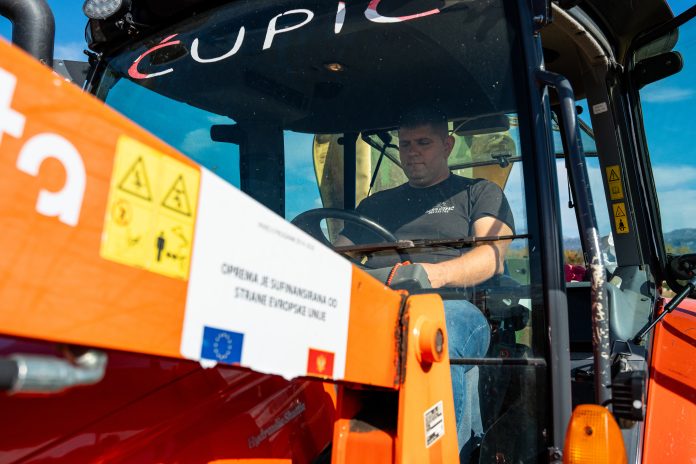

The recent closing of Chapter 11 – Agriculture and Rural Development confirms Montenegro’s progress on its European path, but the concrete effects of this process have been visible on the ground for years. European standards and EU support contribute to the development of domestic agriculture, and one example is Nebojša Ćupić, the owner of the company Agro Ćupić from Danilovgrad, a young livestock farmer who, through knowledge, work, and with the help of the EU, has built a serious farm.
Two years ago, he opened the company Agro Ćupić and today he is successfully engaged in crop farming and livestock breeding.

“We currently have around 50 head of large livestock, about 100 head of small livestock, and agricultural machinery for cultivating land, growing other grains, and mowing grass. My brother and I have been used to working since we were young, so it doesn’t represent a big job or burden for us. What’s important is that a person has the will,” says Nebojša, explaining what their working day looks like: “Our working day starts at 6 a.m. when we begin milking the cows, and thanks to mechanization it takes about two hours. From May to mid-November we let the livestock out to pasture, and then we have no obligations until the evening at 6 p.m.”
Production is organized, stable, and fully market-sustainable, explains the livestock farmer from Danilovgrad.

Although he often hears from older people that “agriculture doesn’t pay off,” Nebojša dismisses that dilemma right away.
“It absolutely pays off. There is absolutely no calculation under which it doesn’t pay off. I don’t know in which job I could earn this much without having to leave the country.”

IPARD – a key pillar for the modernization of agricultural equipment
Ćupić is one of the farmers who used IPARD – a European Union program that provides candidate countries, such as Montenegro, with financial and professional support to modernize their agriculture and rural areas. Through this program, farmers can receive funds for investments in new machinery, equipment, facilities, food processing, or the development of rural tourism, with the obligation to finance part of the investment themselves and meet strict European standards. The essence of IPARD is to help align agricultural production with EU standards and improve the quality of life in rural areas.
“For my first IPARD project, I applied for a large tractor with a loader in 2021. They returned my business plan eight times because it wasn’t written well. But I didn’t want to give up, and I managed to get the project and buy that tractor.”

After the first one, an even more successful second project followed.
“Immediately at the next public call, I applied for machinery and passed on the first try, that was in 2023. Now I’ve applied again; we need a larger tractor, we’ll see how it goes,” Nebojša says with a smile, adding: “If it weren’t for that support, it would be hard to afford this. We would never have been able to procure machinery on our own without EU support.”
Such investments are precisely what prepare Montenegrin farmers for the EU market, where, after Montenegro becomes a member, they will also have access to a much larger fund – the Common Agricultural Policy (CAP), which annually provides billions of euros in support to farmers across Europe.

Chapter 11 – another step toward European standards
Montenegro closed Chapter 11 at the Intergovernmental Conference in Brussels on December 16, and examples like Ćupić show the sector’s readiness to meet European requirements. Closing the chapter means that Montenegro has successfully aligned its laws, policies, and institutions in the field of agriculture with EU rules. This is especially important for young people who want to stay in rural areas and develop their business. Nebojša is one of them.
“From Montenegro’s membership in the EU, I expect everything to be much more modern, faster, and better,” he concludes.