





For more than three decades, the Society of Young Environmentalists Nikšić (SYEN) has constituted one of the most consistent voices in the fight to preserve nature. In 32 years of their continuous operation, the focus of the work of this organization has been equally on improving policies and programmes in the field of ecology and environment protection and on the improvements of general situation in the field.
In the last couple of years, the SYEN has been carefully following the course of negotiations within the chapter 27, contributing actively to the public dialogue and European integration process. It is a part of the Coalition 27, the open platform of non-governmental organizations that jointly follow the negotiation process, advocate transparency and quality of public debate, and prepare the annual “Shadow Report for Chapter 27”, as an affirmative document aimed at accelerating EU integration in the chapter 27.
The Society of Young Environmentalists Nikšić thinks that chapter 27 – Environment and climate change – is one of the most difficult, broadest in scope and financially the most demanding chapters in the process of Montenegro’s accession to the EU. Although formally opened in 2018, its implementation still constitutes a huge challenge for Montenegrin institutions.
Effective implementation of European standards requires strong institutions, political will, significant financial investment, long-term strategic planning, but also active participation of citizens and civil society.
In the years behind, Montenegro has undertaken numerous steps to align its legislation with the EU acquis, improving the legal framework, adopting strategic documents and implementation plans. However, implementation of the planned obligations is not going at the desired pace, particularly in the fields of waste management, air quality, nature protection and response to climate change.
The key thing is to establish a sustainable financing system and strengthen institutional and administrative capacities to meet the obligations from Chapter 27 within the envisaged deadlines.
The exceptional importance of providing the public with an insight into the real significance of Chapter 27 and progress in Montenegro’s EU integration led to development of the project “Chapter 27 – Key to Sustainable Integration of Montenegro on the Path to the EU”. Its basic aim is to explain the process of accession to the EU to local institutions and nongovernmental organizations through the impact chapter 27 on the local level. This project is being implemented in five municipalities in Montenegro (Nikšić, Plužine, Šavnik, Žabljak and Pljevlja).
Through educational workshops, information leaflet, media and digital campaign, public events and lectures for high-school students, the project will provide citizens with explanations of what the Chapter 27 actually means for local communities – from the air and water quality, through waste management to new development and financial opportunities. A particular focus is put on the strengthening of cooperation between local administrations, civil sector and citizens, so that the process of European integration can be more transparent, more understandable and more inclusive.
„Sharing borders, growing closer”
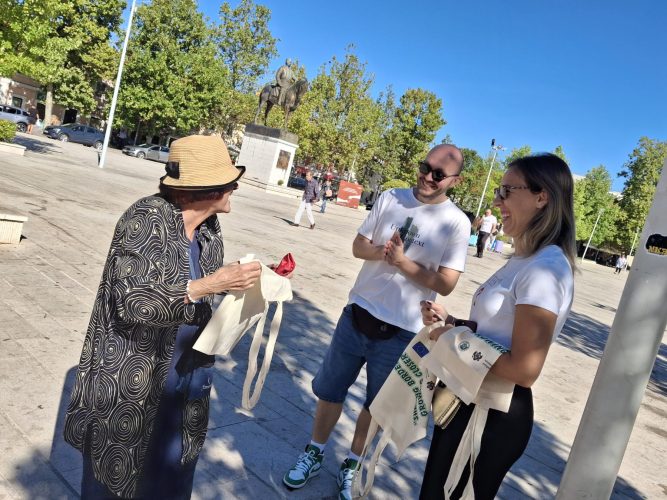
One of the first activities of the project was to celebrate the Day of European Cooperation through a campaign with the citizens in the city square in Nikšić. During a direct communication, citizens were conveyed messages about the importance of the EU territorial cooperation and joint initiatives in culture, economy and environment.
In that context, the participants talked with citizens about chapter 27 and importance of environment protection as a fundamental element of sustainable development, but also as an every-day value that has a direct impact on the quality of their lives.
The campaign was supported by local nongovernmental organizations and the participants in the campaign were distributed textile tote bags with the messages promoting European cooperation and responsible attitude to the environment, as a symbol of sustainable habits and reducing use of plastic.
The role of municipalities in the process of European integration through implementation of standards from chapter 27. This is the title of an information leaflet printed within the project. In a user-friendly and practical manner, the leaflet deals with Chapter 27, focusing in particular on the local level.
It provides an overview of the key sub-areas, clearly indicating to the role and responsibilities of the local self-government units in their implementation. Through explanation of European regulations and standards, it shows that every municipality becomes a holder of sustainable development, and that European policies are implemented in the most concrete and the most visible manner precisely where the citizens live and work.
A separate part of the leaflet is dedicated to the benefits that implementation of the chapter 27 may bring to local communities through: opportunity to enhance the quality of public services through European standards, opportunity to access funds and partnerships of the EU, responsibility to secure cleaner, healthier and more resilient environment to their citizens.
“How does the process of accession to the EU bring benefits to local communities?”
Although European integration constitutes a strategic goal of the state, its implementation largely takes place on the local level – through the work of municipalities, public companies non-governmetnal sector and engagement of citizens – it pervades all aspects of life, from security and protection of human rights to quality of life and economic and environmental standards.
On 11 December 2025, in Nikšić, the project brought together civil sector and local government representatives from Nikšić, Plužine, Šavnik, Žabljak and Pljevlja, within the workshop “How does the process of accession to the EU bring benefits to the local communities?”

The workshop presented current environmental challenges and Action plan for meeting the closing benchmarks in the chapter 27. Participants were informed about the essence of chapter 27, EU methodology, role of local governments in the methodology, stages in the negotiation process, details of the Action plan for meeting the closing benchmarks in the chapter 27, etc. The importance of the eight closing benchmarks in Chapter 27 was particularly underlined.
It was emphasized that the content of the Chapter 27 was based on the European Union acquis in the field of environment protection, which is today regulated in more than 200 legal documents – directives, regulations and decisions of the Council and European Parliament.
It was emphasized that the goal of chapter 27 is to align national legislation and practice with these documents, but also to develop administrative and institutional capacities for their implementation. This includes planning, supervision, implementation and reporting, in line with the basic principles of the Treaty on the Functioning of the European Union, which stipulates that the EU environmental policy relies on:
principle of precaution, principle of prevention, principle of remedy at source, and polluter pays principle.
The importance of adoption of strategic documents on the national level to create a basis for adoption of secondary legislation on the local level was also underlined.
The project focuses also on working with the young and, therefore, will soon organize lectures in five secondary schools in Nikšić, Šavnik and Plužine, where pupils will be explained, in an interactive and visually adapted manner, how the EU and chapter 27 affect their daily lives and their future and what the role of younger generations in the EU integration is.
By: Miodrag Karadzić, NGO Society of Young Environmentalists Nikšić
This text was published in the 17th issue of Eurokaz magazine.