



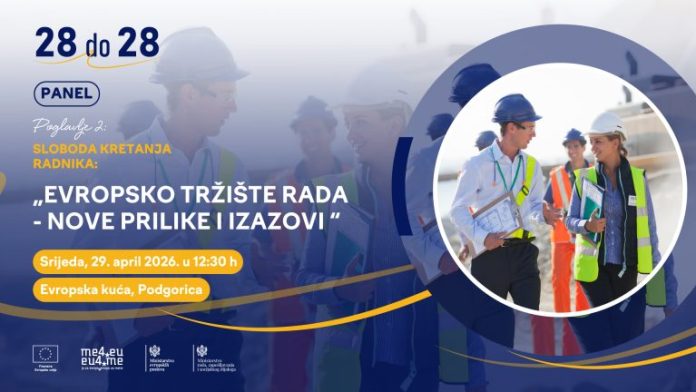

The Ministry of European Affairs and the Ministry of Labour, Employment and Social Dialogue, with the support of the European Union through the EU4ME project, within the “28do28” campaign, are organizing the panel “European Labour Market – New Opportunities and Challenges”, dedicated to Chapter 2 – Freedom of Movement for Workers. The panel will be held on Wednesday, 29 April 2026, from 12:30 to 14:30 at the Europe House in Podgorica (Trg Argentina No. 4).
The event will be opened by the Minister of European Affairs Maida Gorčević and the Minister of Labour, Employment and Social Dialogue Naida Nišić, followed by a discussion through two thematic panels.
The first panel, “Freedom. Employment. Integration – what does Chapter 2 bring?”, addresses the impact of the free movement of workers on the labour market, employment opportunities in EU member states, as well as the rights and procedures accompanying labour mobility. Speakers include Ivana Šućur, Head of the Working Group for Negotiation Chapter 2, Dragan Dašić from the Ministry of the Interior, and Ivana Ružman from the Ministry of Labour, Pension System, Family and Social Policy of Croatia, moderated by Predrag Tomović.
The second panel, “Security. Rights. Mobility – institutional readiness for EU standards”, focuses on the practical implementation of European standards and the readiness of institutions for the obligations arising from EU membership. Participants include Gordana Vukčević from the Employment Agency of Montenegro, who will speak about future obligations within the EURES network, Vladimir Drobnjak, Director of the Pension and Disability Insurance Fund, on coordination of the social security system, Vinka Vukeljić from the Health Insurance Fund on the introduction of the European Health Insurance Card, and Srđan Simović, Chief Labour Inspector, on labour inspection reform in the accession process. The panel is moderated by Ivana Šućur.
Media representatives are invited to attend the event and report on topics of importance for the European integration process and the labour market in Montenegro.