




Vocational education plays an important role in preparing young people for the labour market, because it ensures that they can acquire knowledge and skills that correspond to the requirements of modern society. To ensure that the vocational education system in Montenegro is up to date, integration of technology into the teaching process is an inevitable part of the chain. This has been recognized in the Innovation-Entrepreneurship Centre Tehnopolis, that helps the secondary vocational education establishments, with the support of the projects financed by the EU, to improve implementation of curricula and achieve learning outcomes.
With a view to strengthening competences of pupils in secondary vocational education, through two projects of cross-border cooperation, Tehnopolis ensured that the Secondary vocational school in Nikšić can modernize teaching in vocational subjects. Thanks to that, this establishment uses modern equipment today and provides pupils with an opportunity to acquire practical skills that are very important for an increasingly dynamic business environment.
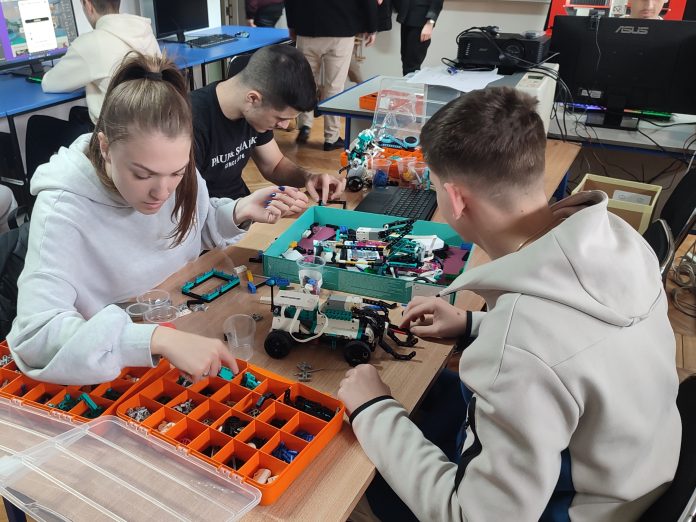
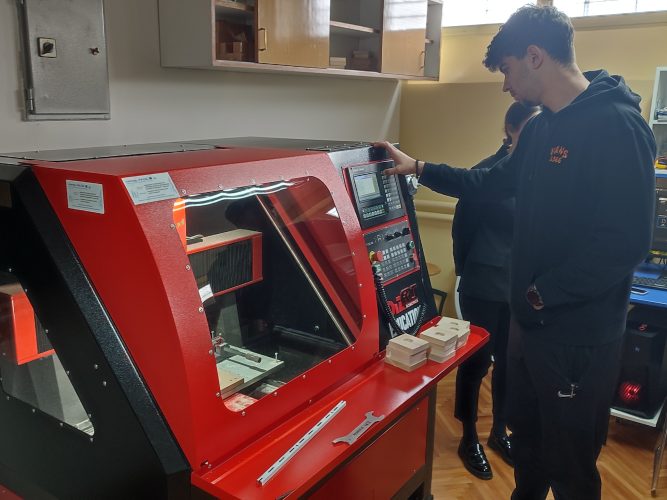
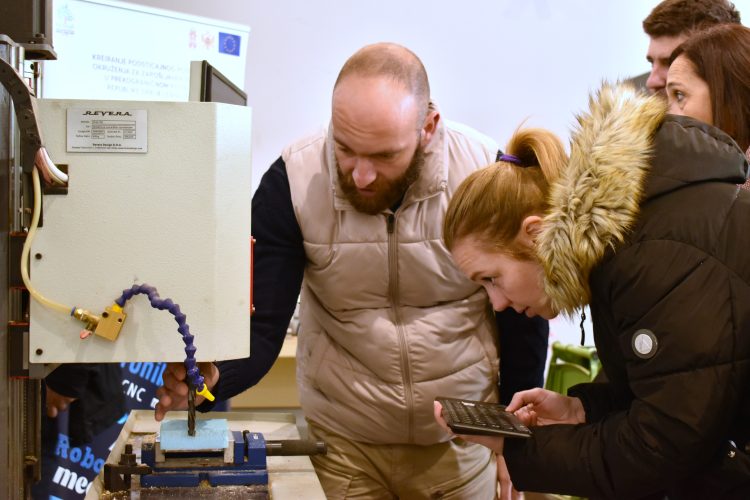
Through the project Innovanet, financed by Interreg IPA Programme of Cross-border Cooperation Croatia – Bosnia and Herzegovina – Montenegro 2014-2020, Tehnopolis equipped robotics and mechatronics room in the Secondary Vocational School, purchasing valuable equipment like 3D printer, CNC machine, set of educational robots, educational set for coding, little educational robot hands, solar micro power plant, micro wind power plant, sumobot and set of sensors for smart houses. This equipment is additionally supported by purchase of professional educational robot cell through the project BEYOND, supported by the funds of the Cross-Border Cooperation Serbia – Montenegro 2014-2020.
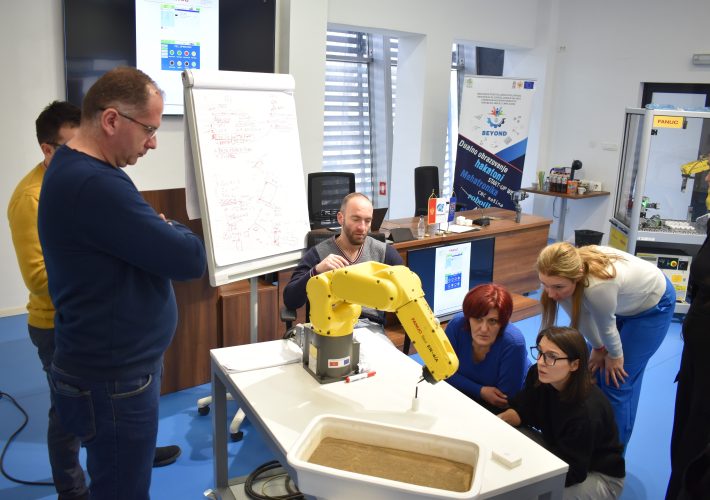
„Work with this kind of equipment was a real challenge for me – particularly starting the robot and its programming, which requires patience, preciseness and good technical knowledge“, says Luka Lučić, a third-grade pupil in the course for web and mobile application developers.
„I would particularly emphasize the experience of working with the FANUC robot cell that I had the honour to present in the Days of Science in our school. Through extra curriculum activities we had an opportunity to connect the knowledge from various fields, which helped me to apply theoretical knowledge to concrete practical examples.“
Viktor Smolović, a student in the course of electrical engineering – energy sector, that this year participates in the international competition Balkan Junior in Slovenia, shares his opinion.
„The task is very challenging, but our work is made easier by a 3D printer and Arduino set. We have made parts using the 3D printer, electronics, engines, sensors and plates. We put the parts together on a conveyor belt and used other parts to sort colours. This experience will be very helpful for further development within my education“, says Viktor.
In addition to participation in competitions, the purchased equipment is used for the science fair that this school was organizing for the last two years within the event Science Days.
„I had an opportunity to participate in the science fair with my classmates. We presented projects of designing electrical installations for a house where we connected solar panels using the ‘OFF grid’ system. This helped me to improve skills in the field of designing, but also to better understand how the renewable energy sources function“, says the pupil Ivan Koprivica and adds: “Working on this project, we have also developed some ideas for further improvements of the system by adding smart managing of energy consumption through Arduin, for example.“
To improve the quality of teaching, it is particularly important to train the teaching stuff to implement innovative pedagogical methods. Since the teachers had not had any opportunity to work with the purchased machines in the past, the projects Innovanet and BEYOND organized practical cross-border trainings for them in robotics, mechatronics, work on CNC machines and 3D design. Thanks to that, the teachers can now apply the acquired knowledge in working with their students.
Professor Snežana Nikolić also confirms that the teaching process is different.
„The difference is major. Before new equipment was introduced, the teaching was more theoretical and based on simulations. Now the pupils have an opportunity to work directly on modern devices, which increases the quality of teaching process, interactive work and understanding of complex systems“, says Nikolić for Eurokaz.
As she says, there is more teamwork, experimenting and development of creative solutions, which used to be limited earlier. She has also noted an increased interest of pupils for vocational subjects, as well as their better self-confidence when working on technical problems.
„Pupils increasingly often take initiative to take part in extra curriculum activities like competitions, workshops and projects in cooperation with IPC Tehnopolis and other associates“, says Nikčević.
As she noted, cross-border trainings had been very useful, the most serious challenge being mastering new technologies in a short period of time.
„The lecturers were very professional and thorough. We got an insight into new trends in education and industry, and we also had an opportunity to connect with other schools and experts in the field“, says Nikčević.
Her colleague Vladana Mirković says that trainings for 3D printing, CNC technology and managing robot hand were particularly useful because they ensured acquisition of practical knowledge and self-confidence in working with the equipment.
„During the training for 3D printing, one of the challenges was to master software tools for modelling and preparing files for printing, while with CNC technology and the robot hand it was of key importance to master preciseness skills.“ Says Mirković.
Jovana Miličić, who teaches Designing of micro-controllers, adds that Arduino equipment makes the teaching process much more dynamic. „Now we can do practical activities like managing LED diodes, engines and sensors“, she says.
Using new technologies has had a positive impact on the interest in enrolment into this school, and thus the number of pupils who enrolled in the last couple of years increased significantly. For example, in the academic year 2021/2022 they enrolled 367 pupils, while in 2024/25 the number was the record-high 526.
School management is very happy with these results. They underline how important it is to cooperate with the local community, including the Tehnopolis projects with the EU support.
„This cooperation ensures that we can modernize the teaching process and provide pupils with the education that follows modern trends in technology. All of this improves the quality of the teaching process, motivates pupils and makes them more secure and creative. In the end, it opens better possibilities for their employment“, says Milisav Kosović, the school principal.
Thanks to the new equipment, the school has been making significant results in the municipal, national and international competitions.
„Our school is the only school from Montenegro that is a member of the Association of Technical Schools of the Balkans (Balkan Junior) and every year we participate in the competition. It was precisely the purchased equipment that ensured implementation of the practical part of the competition when we hosted it. In addition, we can also boast with the successes in the competitions in informatics, robotics, energy and other areas“, concluded Kosović.
Tehnopolis is particularly proud that their projects bring concrete benefits to the local community.
„What I am particularly glad to say is that our projects keep producing results even after they are formally finished, which shows that Tehnopolis always tries to make a permanent change. Enthusiasm of teachers contributes to this. Without their support, we could not achieve such significant results“, says Đorđije Malović, CEO of Tehnopolis.
He has emphasized the importance of cross-border projects for improvements in employability of young people.
„Our activities are largely focused on improving the knowledge and skills of young people so that they could successfully respond to the future labour market needs. Support of the European Union through these programmes is of key importance, because it ensures connections between education and economy. In that way, we do not only keep young people in Montenegro, but build competitive economy for the future“, concludes Malović.
By Stefan Bulatović, Ministry of European Affairs
This text was published in the 16th issue of Eurokaz magazine.